

- Inherited stocks and taxable investments generally receive a step-up in basis to fair market value at the date of death, which eliminates capital gains accumulated during the original owner’s lifetime.
- Washington’s community property laws can result in a full step-up on jointly held assets at the first spouse’s death — a significant advantage compared to non-community property states.
- Not all inherited assets follow the same rules: traditional retirement accounts don’t receive a step-up in basis and are taxed as ordinary income when distributed, while irrevocable trust assets may also be excluded.
Inheriting stocks, mutual funds, ETFs, or other investment assets can feel like a meaningful financial windfall, but it often comes with more uncertainty than clarity at the beginning.
Many beneficiaries find themselves asking practical questions, such as, “What did I inherit?” “What is fair market value?” “Should I sell?”
These questions arise because inherited investments are not simple transfers of value.
They sit at the intersection of tax rules, estate planning, and personal financial decisions. Each of these areas influences the overall outcome, and they do not always work together seamlessly.
The complexity is also highly situational. Two beneficiaries inheriting similar assets may face very different tax implications depending on ownership structure, timing, and what decisions are made after the transfer.
At a high level, inheriting investments involves:
- Federal tax rules governing capital gains tax and tax basis
- State-level considerations, including the Washington estate tax and capital gains tax
- Transfer logistics across custodians, trusts, or estate proceedings
- Personal planning tied to income, risk tolerance, and long-term strategy
When you understand how these pieces work together, an inheritance can shift from uncertainty to a more informed position.
Inheriting Stocks: The First Tax Facts Beneficiaries Need
When you inherit stocks or other taxable investments, you are receiving legal ownership of assets that were previously held by another individual. While ownership transfers relatively cleanly, the tax rules reset how those assets are treated in a simple but important way.
At the center of this transition is tax basis, often called cost basis. Investors use this value to calculate capital gains or losses when an asset is sold.
For a typical investor, cost basis is:
- The original price paid for an asset
- Adjusted over time for dividends, splits, or reinvestment
What Happens to Tax Basis at Death?
Step-Up In Basis
Instead of carrying forward the original purchase price, inherited investments generally receive a new tax basis equal to the fair market value at the date of death.
For assets that have increased in value, this is known as a step-up in basis, one of the most impactful tax provisions in estate planning.
The step-up in basis is sometimes described as a “tax loophole” in public debate because of the significant tax savings that can result from it, though it is a longstanding provision of federal tax law.
Understanding how it works and applying it as part of a broader estate plan is straightforward tax planning.
This means:
- The original owner’s cost basis is essentially erased
- The new basis reflects current value at inheritance
- Only future gains become taxable
Because of this, the step-up in basis can dramatically reduce any potential tax liability for beneficiaries and is a helpful tool to use in legacy and estate planning.
To illustrate how step-up in basis works, consider an investor who purchased stock for $50 many years ago. By the time of their death, the shares are worth $120.
When those shares are inherited, the beneficiary uses $120 as the new cost basis, not the original $50 purchase price.
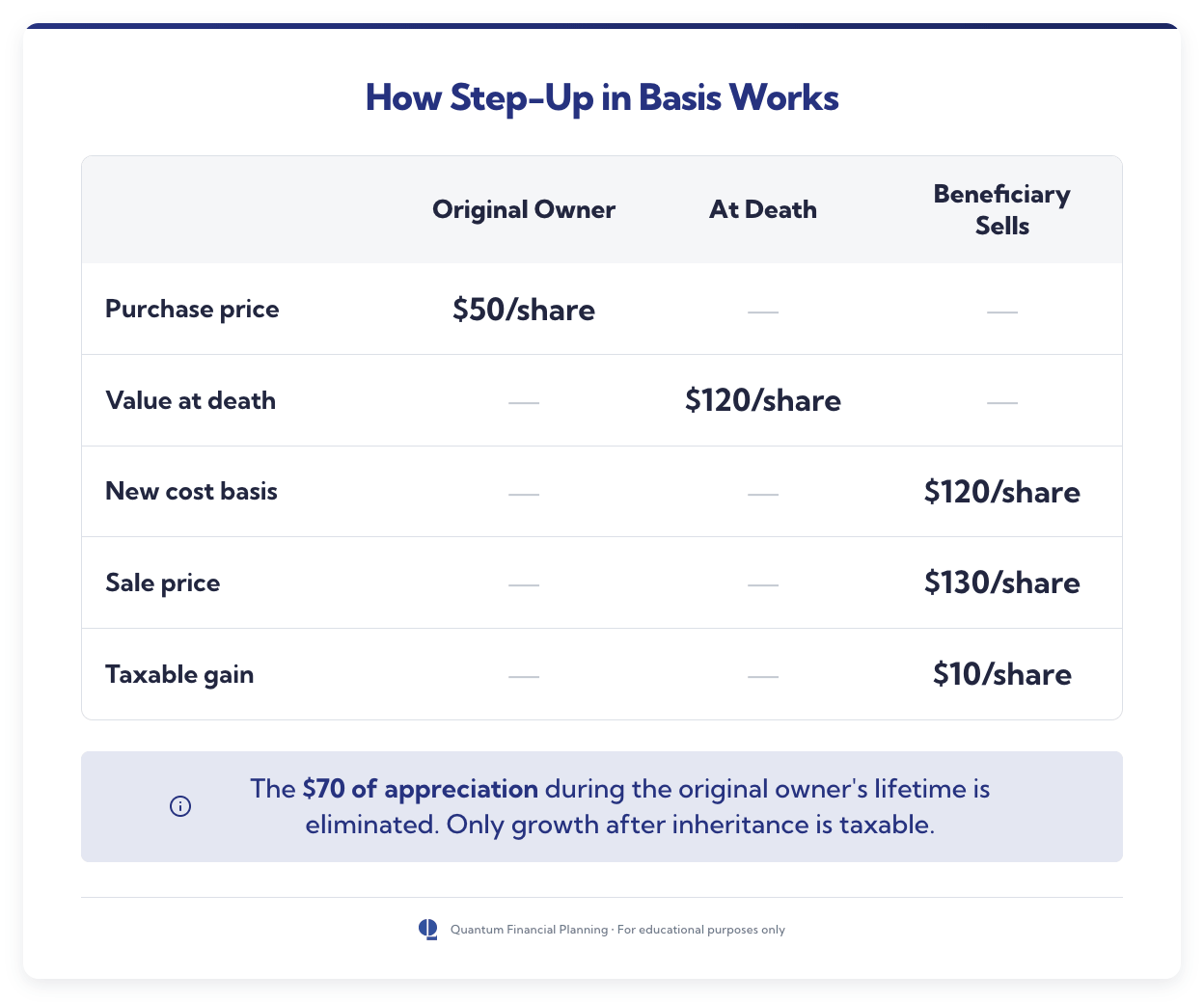
If the beneficiary later sells the stock for $130, the taxable gain is only $10. The $70 of appreciation that occurred during the original owner’s lifetime is effectively eliminated for tax purposes.
This is why step-up in basis is often considered one of the most significant tax provisions associated with inherited stocks, as it can substantially reduce historical capital gains that would otherwise be taxable.
Step-Down In Basis
It’s important to recognize that this fair market value adjustment is not always favorable. If the value of an asset declines before death, a step-down in basis may apply instead.
In that case:
- The asset’s basis is adjusted downward to a lower fair market value
- The beneficiary may have fewer opportunities to claim future losses
- A beneficiary may have taxable gains even if they sell the asset for less than the original owner paid for it
- Overall tax planning flexibility may be reduced

Understanding how step-up (and step-down) in basis works is essential for evaluating the true tax implications of inheriting stocks or other investment assets.
The 6-Month Alternate Valuation Rule
In most cases, the step-up in basis is calculated using the fair market value on the date of death. However, an estate executor may elect to use an alternate valuation date, the value of assets six months after the date of death, under specific IRS rules.
This election is only available when it reduces both the total value of the estate and the estate tax owed. It applies to the entire estate, not individual assets, and cannot be used selectively.
If assets have declined in value after the date of death, this election can result in a lower estate tax bill, but it also means a lower stepped-up basis for beneficiaries, which could increase future capital gains taxes.
This is a planning decision that requires coordination between the estate executor, a CPA, and potentially a financial advisor, as the tradeoffs between estate tax savings and future capital gains exposure are not always straightforward.
Publicly Traded Investment Valuation
For publicly traded investments, such as stocks, ETFs, and mutual funds, establishing value is usually straightforward. Unlike private investments or real estate, these assets have readily available market pricing.
Typically, valuation is determined using one of the following approaches:
- The average of the high and low trading price on the date of death
- The closing price on that date
While these approaches may produce slightly different values, the exact number matters because beneficiaries use it as the cost basis to calculate future gains or losses, so consistency across records is essential.
If valuations don’t align, it can create confusion or attract IRS attention, but keeping detailed records of your valuation approach can make any potential audit much easier to manage.
What Assets Do and Do Not Receive a Step-Up in Basis
A common source of confusion is assuming that all inherited assets receive the same tax treatment. In reality, the step-up in basis applies primarily to taxable investments.
These include stocks, bonds, ETFs, and mutual funds held in non-retirement brokerage accounts.
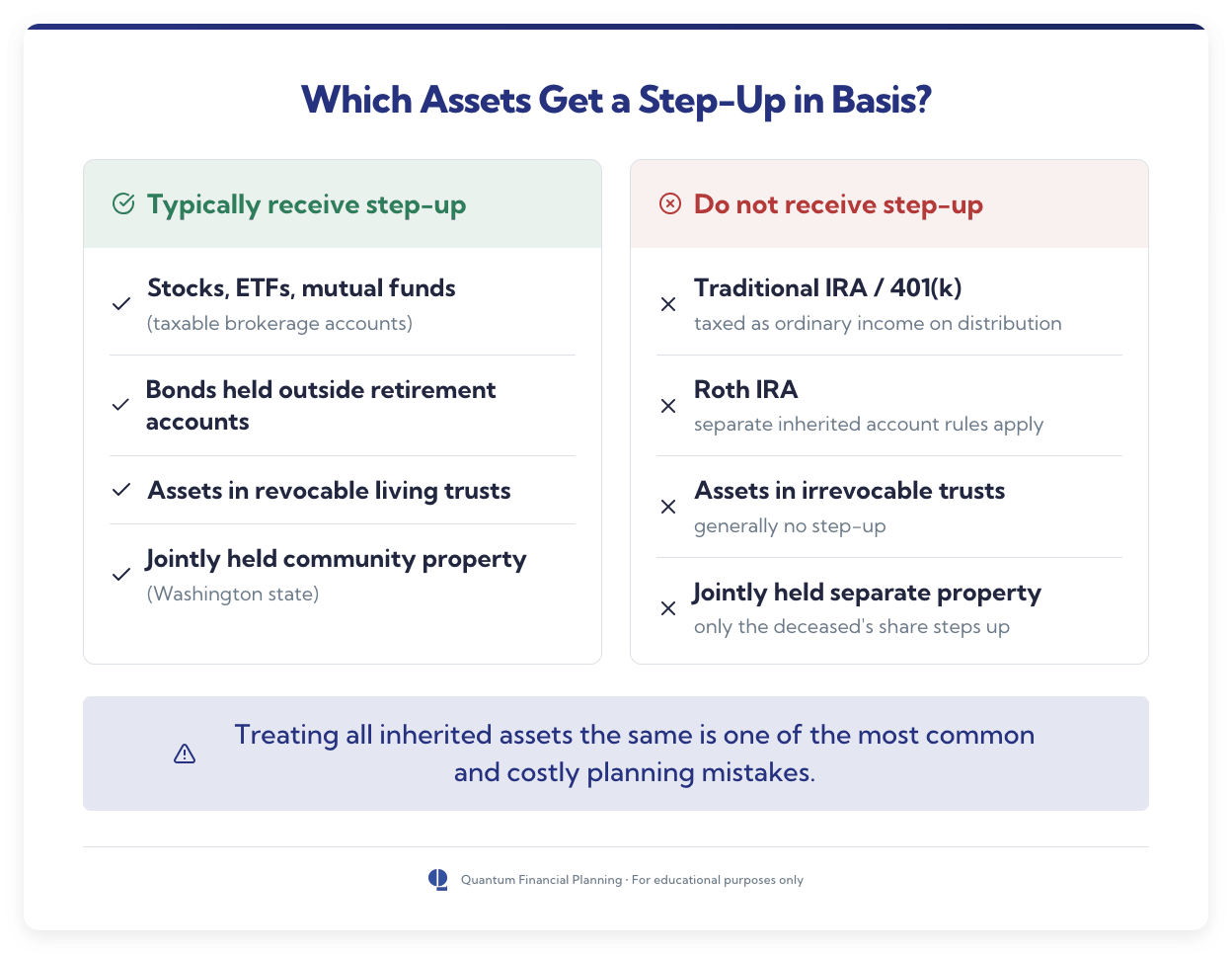
By contrast, certain qualified retirement accounts follow entirely different rules. Traditional IRAs and 401(k)s, for example, are generally taxed as ordinary income when distributions are taken.
Roth accounts follow their own set of inherited distribution rules, but are generally non-taxable to beneficiaries.
This distinction matters because it directly impacts both the timing of distributions and overall tax strategy. Treating all inherited assets the same can lead to unintended and often unfavorable tax outcomes.

Inherited real estate generally follows the same step-up rules as stocks and taxable investments. However, If you’ve inherited both investments and real estate, each asset type carries its own pros and cons and they are worth evaluating separately for tax and financial planning purposes.
How Ownership Structure Changes the Tax Result
One of the most commonly overlooked factors in inherited investment planning is how the asset was owned before death. Even when two assets are identical, their tax treatment can differ significantly based on ownership structure.
For Washington residents, this distinction is especially important due to the state’s community property laws, which can materially affect the step-up in basis and future tax liability.
The most common account ownership structures include:
- Individually owned accounts
- Jointly owned accounts
- Trust-owned assets
Each ownership structure carries its own tax implications. Depending on how the asset is held, it may receive a full step-up in basis, a partial adjustment, or in some cases, such as certain trust-owned assets, no step-up at all.
Washington State Community Property Laws
Under community property rules, assets owned jointly by spouses may receive a full step-up in basis upon the death of one spouse.
This can significantly reduce future capital gains exposure, particularly for long-held investments that have appreciated substantially over time.
Example – Community Property Tax Benefits
For example, imagine a married couple in Washington purchased $10,000 of Microsoft stock in 2001, and it has since grown to $300,000.
Because Washington is a community property state, a full step-up in basis at the first spouse’s death could eliminate the entire $290,000 unrealized gain—allowing the surviving spouse to sell the stock with little to no capital gains tax.
By contrast, if the stock were treated as separate property (such as in non-community property states) only the deceased spouse’s half would receive a step-up.
In that case, half of the investment would be adjusted from $5,000 to $150,000, while the surviving spouse’s half would retain its original $5,000 basis.
As a result, if the surviving spouse sells, there would be approximately $145,000 in taxable gains.

While Washington laws give these assets favorable tax treatment, not all states treat jointly owned assets the same.
There are several aspects to consider carefully, such as:
- How the asset is titled (e.g. rights of survivorship or tenants in common)
- Whether it was classified as community property
- How contributions were made
Washington also recognizes community property trusts, which some married couples use to give separate property assets community property treatment.
For assets that would otherwise be considered separate property, holding them in a community property trust may allow both halves to receive a step-up at the first spouse’s death.
Trust and Joint Ownership Considerations
Trusts introduce another layer of complexity.
Revocable living trusts, which are commonly used in estate planning, are often treated similarly to individually owned property for tax purposes.
As a result, these trusts typically allow assets to receive a step-up in basis just like they would if they were individually owned.
Other types of trusts, however, have different purposes and rules. Some may have separate tax structures, while others may affect how and when assets are distributed.
Irrevocable trusts are often used to effectively reduce estate taxes. Assets held in these trusts however don’t typically get a step-up in basis, which could result in taxable gains far beyond the date of death.

Because these details are not always obvious from account statements alone, reviewing ownership structure is an essential part of planning around inherited assets.
The Records Beneficiaries Need Before Making Moves
Before making any investment decisions, it is essential to establish accurate records. This lays the foundation for everything that follows.
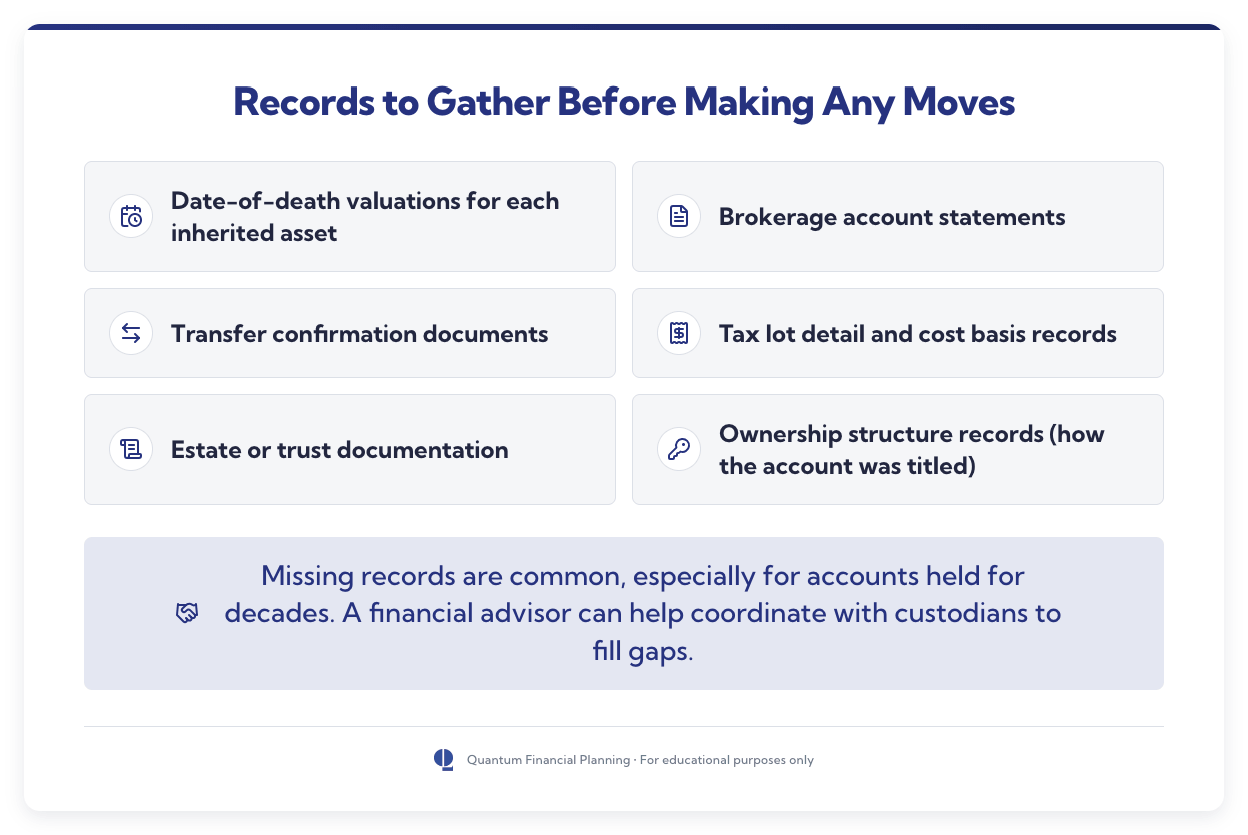
In practice, this process is not always smooth. Many beneficiaries encounter gaps in records, especially when accounts have been held for long periods or involve multiple transactions.
Common challenges include missing cost basis data, incomplete transaction histories, and confusion around reinvested dividends. These issues can complicate tax reporting if not resolved early.
If you’re working with a CERTIFIED FINANCIAL PLANNER® professional, they can help coordinate with investment firms to locate and verify accurate cost basis records.”
Once the necessary documentation is in place and the cost basis is clearly established, you can make informed decisions about if and when you should sell these inherited assets.
Selling Inherited Investments and How Gains Are Taxed
When inherited investments are sold, the taxable gain is calculated based on the difference between the sale price and the adjusted basis.
Because the basis is typically stepped up to the date-of-death value, any appreciation that occurred during the original owner’s lifetime is not subject to tax. Tax calculations generally include only growth after inheritance.
Another feature of inherited assets is that they generally receive long-term capital gains treatment, regardless of how long the beneficiary holds them. This can result in more favorable tax rates compared to short-term gains.
Oftentimes, beneficiaries who sell assets shortly after inheritance experience minimal taxable gain or loss, because the market value has not changed significantly since the date of death.
How WA State Taxes Affect Inherited Investments
While federal rules determine how basis works, Washington State introduces additional considerations that can influence overall tax outcomes.
Washington is somewhat unique in that it does not impose a traditional state income tax. This means that income sources such as dividends and IRA distributions are not taxed at the state level for most residents.
For beneficiaries, this can provide additional flexibility in managing income streams after inheritance.
However, Washington State does apply a state-level long-term capital gains tax on certain realized gains.
Washington Capital Gains Tax
Currently, the state provides an annual exemption of $278,000, meaning gains below this threshold are not subject to the tax.
However, gains above this threshold are taxed as follows:
- Gains between $278,000 and $1 million are taxed at a 7% rate
- Gains above $1 million are subject to an additional 2.9% excise tax, resulting in a higher effective tax rate of 9.9%
When you combine these rates with federal taxes, high-earning Washington residents could pay as much as 30% on some investment gains.
While the step-up in basis often reduces potential taxable gains on inheritance by resetting the cost basis to fair market value at date of death, any appreciation that occurs after inheritance may be subject to these Washington capital gains taxes if total gains exceed the exemption threshold.
📰 → Washington State Capital Gains Tax: A Comprehensive 101 Guide.
Washington Estate Tax
Washington also imposes an estate tax on estates exceeding $3 million. This is separate from the federal estate tax, which applies to estates above a significantly higher threshold, currently $15 million per individual.
Most WA residents aren’t subject to the federal estate tax. Yet the state’s lower threshold means it can apply to far more families than many expect.
Washington does not impose an inheritance tax on beneficiaries. The estate tax is paid by the estate before assets are distributed, not by the person(s) receiving them. The two terms are often used interchangeably, but they describe different tax systems.
Although this tax is paid by the estate rather than the individual beneficiary, it can reduce the total value of assets ultimately passed down to heirs. Once the tax picture is clear, the more interesting question is what to actually do with what you’ve inherited.
📰 → Washington Estate Tax: Everything You Need to Know
Inheriting Stock and Deciding Whether to Keep or Sell
Once the technical aspects of taxes and valuation are understood, the conversation shifts to a more practical question: what should you do with the inherited investments?
This decision is less about tax mechanics and more about financial planning. Beneficiaries should evaluate inherited assets within the broader context of their own financial picture.
Key considerations include goals, stage of life, risk tolerance, time horizon, and liquidity needs.
In many cases, inherited assets reflect the original owner’s preferences rather than the beneficiary’s. A portfolio built by a parent over 30 years may carry concentrated positions, sector biases, or a risk level that fit their timeline but doesn’t fit where their child is today.
One common issue is concentration risk. For example, inheriting a large position in a single company stock can create excessive exposure, potentially increasing the volatility in your portfolio, even if the investment has performed well historically.
The step-up in basis creates flexibility here. Because past gains are reset, beneficiaries often have more freedom to sell concentrated positions, rebalance their portfolio, and diversify across asset classes without triggering significant tax consequences.
When Keeping the Investment May Still Make Sense
Despite this flexibility, selling is not always the best course of action. In some cases, the inherited investment may already align well with the beneficiary’s overall strategy.
This may be true when the portfolio is already diversified, when the assets provide consistent income, or when they support long-term growth objectives.
The key is to evaluate whether the investment still fits within your financial plan. While tax efficiency is important, it should not be the sole driver of decisions. An investment that no longer aligns with your goals may warrant adjustment, even if the tax impact is minimal.
Situations That Can Complicate Inherited Investments
Not all inherited assets are easy to evaluate or manage. In some cases, additional complexities arise that require more detailed analysis.
These situations may involve:
- Closely held business interests with limited market pricing
- Restricted or employer stock with transfer limitations
- Private investments with delayed valuations
- Multiple beneficiaries sharing assets
In addition, delays in estate or trust administration can affect when assets are received and what information is available at the time decisions need to be made.
For example, if you inherit shares of a family business with no public market price, getting an accurate valuation typically requires a formal appraisal
Another common source of confusion is the difference between estate tax and capital gains tax. Estate tax applies before assets are distributed, while capital gains tax applies only when assets are sold. These systems operate independently and should be evaluated separately.
Planning Opportunities After Inheritance
While inheriting investments can initially feel overwhelming, it also presents a valuable opportunity to improve your financial position.
Because of the step-up in basis, beneficiaries have a chance to realign their investment strategy to their goals with reduced tax friction.
This can be an ideal time to:
- Reevaluate your team of experts – Financial Advisor, CPA, Attorney
- Consolidate accounts across institutions
- Simplify investment structures
- Diversify concentrated positions
- Align assets with long-term goals
One distinction worth noting for your own estate planning: assets transferred as gifts during your lifetime do not receive a step-up in basis. The recipient carries over your original cost basis instead.
For appreciated assets, this can make a real difference, which is why the decision to gift versus hold until death often has meaningful tax implications for heirs.
The annual gift tax exclusion allows tax-free transfers up to a set threshold each year, but the basis question is separate from whether gift tax applies.
In many ways, inheritance is not just a transfer, it is a starting point for a new phase of financial planning and an opportunity to integrate inherited assets into broader planning strategies involving income, taxes and your own future legacy.
If you received a significant inheritance, it may be worth reviewing whether your current team of advisors has experience working through these complexities.
Inheriting Stocks or Investments FAQs
What is a step-up in basis for inherited stocks?
A step up in basis resets the asset’s cost to its fair market value at the time of death, reducing future capital gains taxes.
Do all inherited investments receive a step-up in basis?
No. Taxable assets typically do when held by an individual or revocable trust. However, retirement accounts follow different rules and certain estate planning tools such as irrevocable trusts complicate this further.
Can inherited stock be sold immediately?
Yes, once ownership is transferred to the beneficiary, and doing so often results in minimal tax impact.
Are gains on inherited stock taxed as long-term capital gains?
Generally, gains on the sale of inherited assets are treated as long-term capital gains, even if they’re sold within a year of the date of death.
Do inherited IRAs follow the same rules as assets in taxable brokerage accounts?
No, they are governed by specific income tax and distribution requirements.
What records should I keep?
Valuations, statements, transfer documents, and confirmed cost basis records are a good starting point. A good financial planning team can work with you to make the inheritance process smoother.
How We Help Families Navigate Inherited Investments
Inheriting investments is less about paperwork and more about decisions: what you own, what it’s worth under the new rules, and what to do with it.
The step-up in basis can give beneficiaries real flexibility that the original owner didn’t have. Using it well means understanding the tax structure, confirming the records, and evaluating inherited holdings against your own financial goals rather than the original owner’s.
Our experienced team at Quantum Financial Planning works with families navigating inherited investments across all of these dimensions, from confirming cost basis and ownership structure to discussing the considerations involved in holding, selling, or restructuring inherited assets.
If you’ve recently inherited stocks or other investments and want a clear picture of where things stand, we’d welcome the conversation.
→ Book a Complimentary Insight Call