

- Washington offers retirees some genuine advantages, but like any state, it comes with trade-offs that depend heavily on your priorities and financial situation
- Your zip code matters more than you might expect: costs, climate, and lifestyle can vary significantly depending on which side of the Cascades you land on
- “No income tax” is a great headline, but it’s not the whole story — Washington’s full tax picture has a few moving parts that are worth understanding before you make any decisions
Finding the right place to retire is not a one-size-fits-all process and oftentimes requires the consideration of a number of different factors.
Whether it’s access to quality healthcare as you age, minimizing your tax burden, or the allure of natural beauty and outdoor recreation, Washington offers a compelling retirement destination.
Whether the Evergreen State is a good place for you to retire, however, depends on your personal goals.
In this post, we’ll walk through the pros and cons of retiring in Washington state, as well as some financial factors to consider. We’ll also give you a curated list of some great places to retire in the state.
What Retirees Typically Look for in a Retirement Destination
Healthcare Access
Access to quality healthcare is understandably a top priority for many retirees. Whether it’s proximity to premier medical centers or plentiful long-term options, checking these boxes brings peace of mind as health needs evolve over time.
Tax Friendliness
If you’re like most retirees, you’ve worked hard to build your nest egg and now you’re relying on it. Reducing the amount you pay in taxes can go a long way in helping to make that money last.
While federal income taxes remain consistent regardless of where you retire, each state has its own tax system and they vary widely from one to the next.
In Washington, residents benefit from the lack of a traditional state income tax, but must consider a higher-than-average sales tax rate, property taxes, estate taxes, and capital gains taxes.
Affordable Cost of Living
Beyond taxes and healthcare, your day-to-day expenses have a big impact on the longevity of your retirement savings.
Finding a retirement destination where your dollar goes further makes a world of difference. Although cost shouldn’t be the only factor you consider, understanding how your city’s cost of living compares to others allows you to make an informed decision.
Washington boasts plenty of options that fit a wide range of budgets.
From bustling but pricier big cities like Seattle and its suburbs that sit between the Puget Sound and the Cascade Mountains to more affordable options in other parts of the state, striking a balance between a reasonable cost and amenities that enhance your life is the goal.
Quality of Life and Personal Fulfillment
Enjoying your retirement requires more than good healthcare. For many seniors, it’s important to find a community that supports your interests, hobbies, and lifestyle.
Whether you’re hitting the trails, the pickleball court, the ski slopes, or the local fairways, Washington’s diverse landscapes and mild climate offer the perfect backdrop for your favorite hobbies.
The relaxed Pacific Northwest pace of life makes it easy to put down roots in a meaningful way.
Pros of Retiring in Washington State
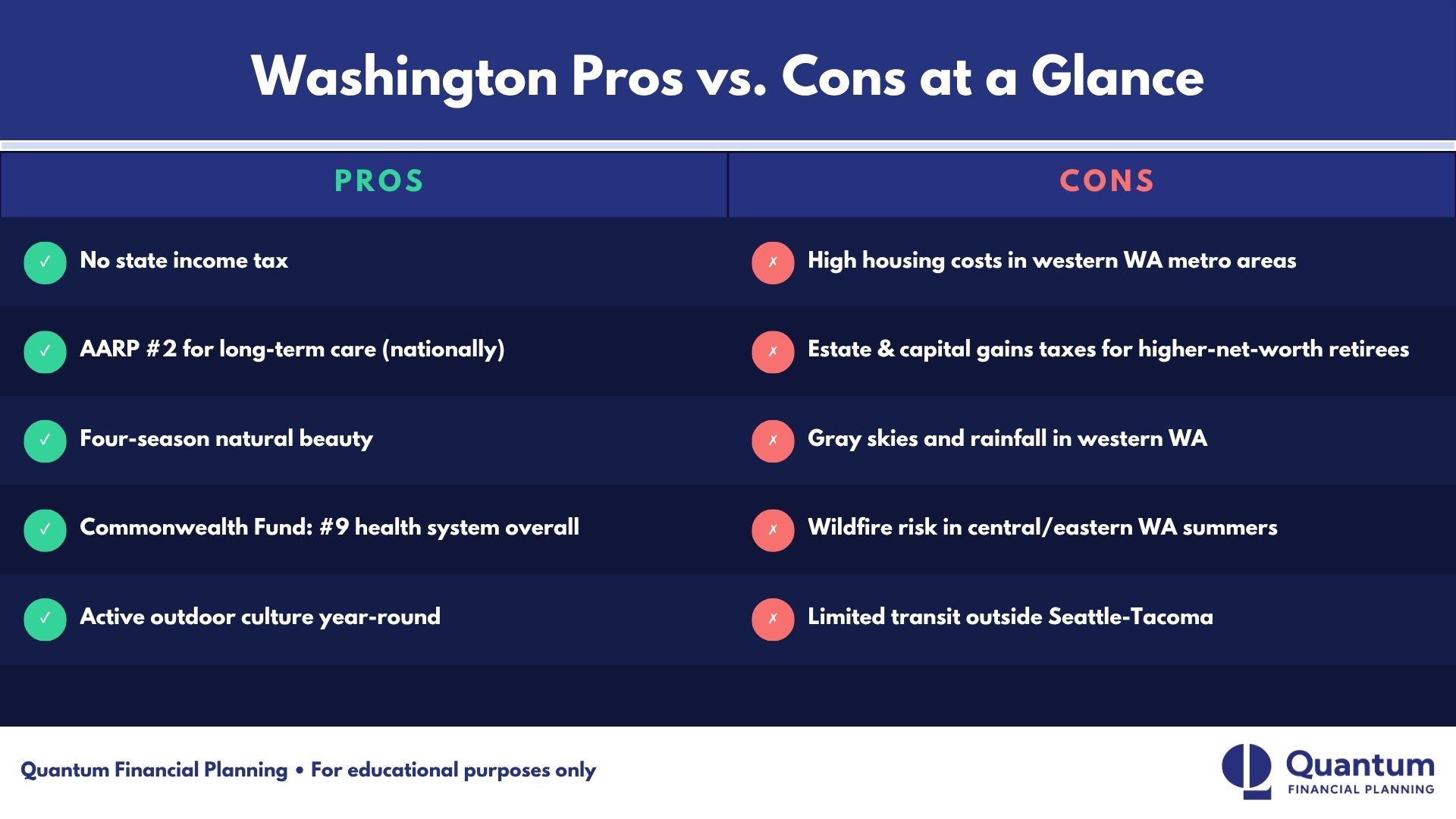
No State Income Tax
Whether you’re living on a fixed income like Social Security or a pension, drawing from retirement accounts, or still earning some income, Washington’s lack of a traditional state income tax can be a plus.
Fewer taxes mean your dollars go farther to fund the retirement you want to live.
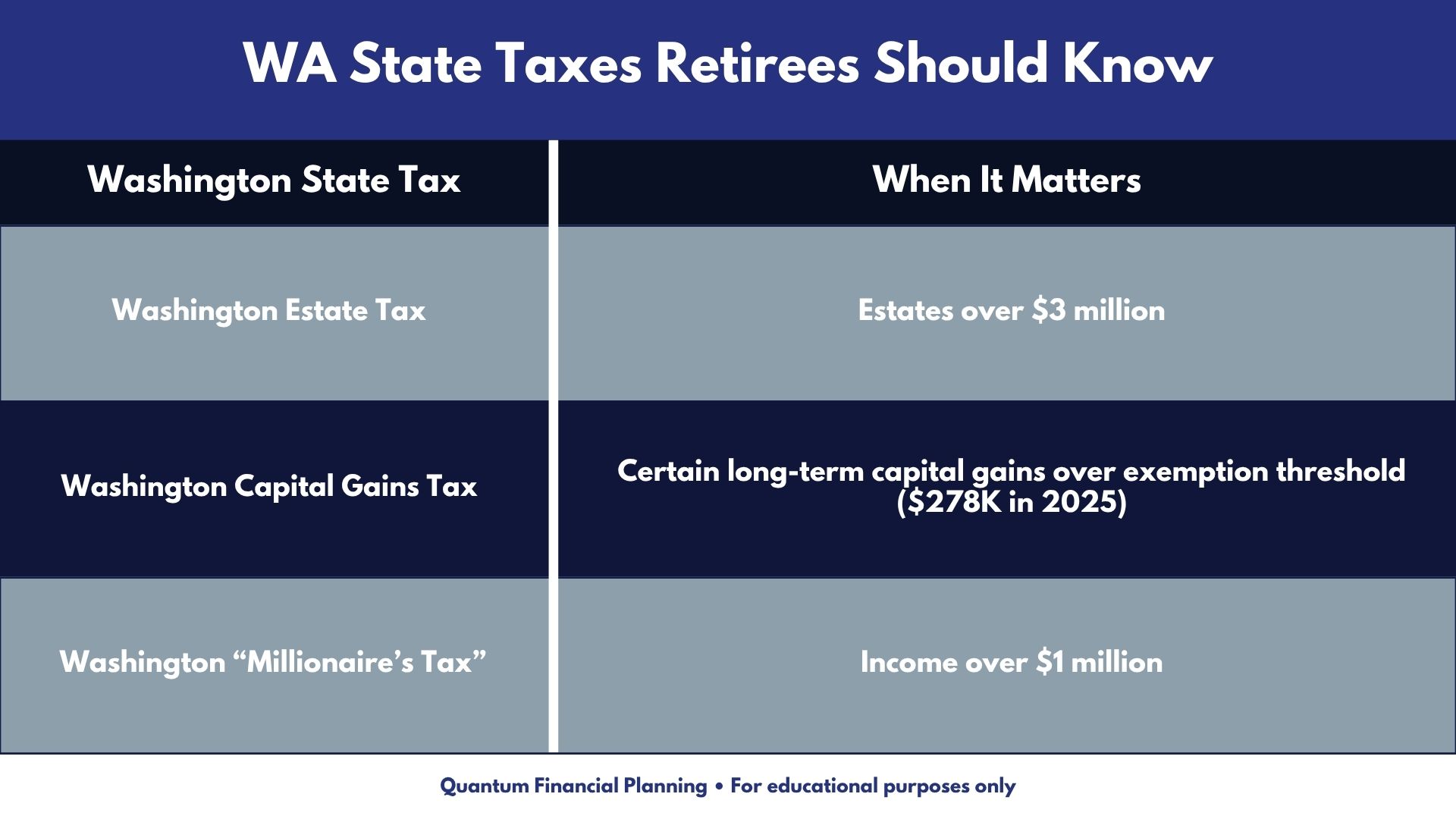
It’s worth noting that while most Washington residents are not subject to state income taxes, the state does have a state capital gains tax and recently passed a “Millionaire’s Tax”, both of which can affect high-net-worth and high-earning residents.
Top-Tier Healthcare
Healthcare quality and accessibility are key considerations when choosing a retirement destination. The Evergreen State checks this box with strong healthcare systems and acclaimed medical centers throughout the state.
Additionally, AARP has recognized Washington as the #2 state in the nation for long-term care services and support.
Scenic Diversity
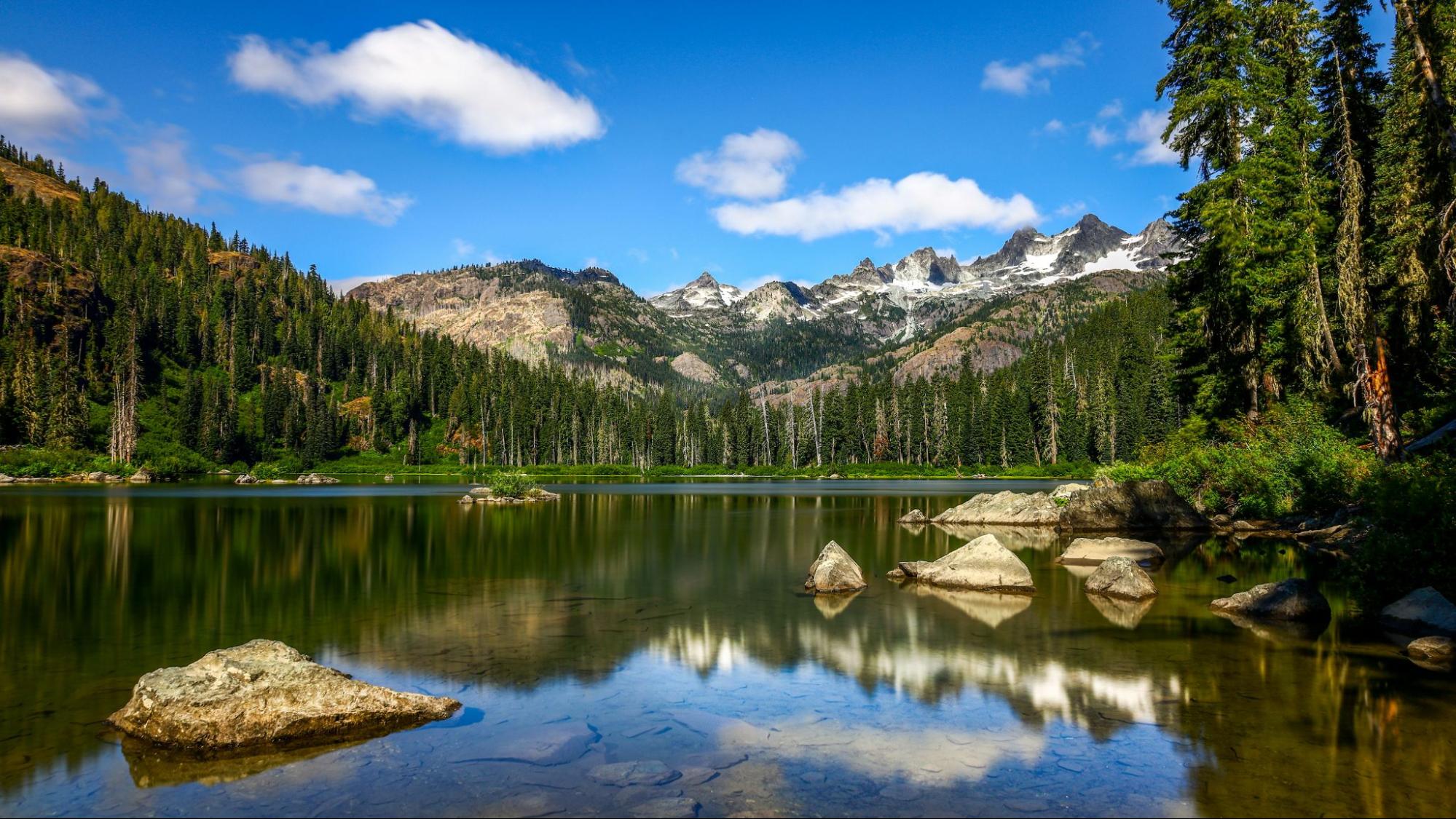
From the rugged coastline and dense forests of the Olympic Peninsula to the Cascade Mountains and the rivers, lakes, and rolling hills of Eastern Washington, the state offers plenty of natural beauty.
Travel + Leisure agrees, naming Washington as one of the most naturally beautiful states in the country.
Mild Weather (Mostly)
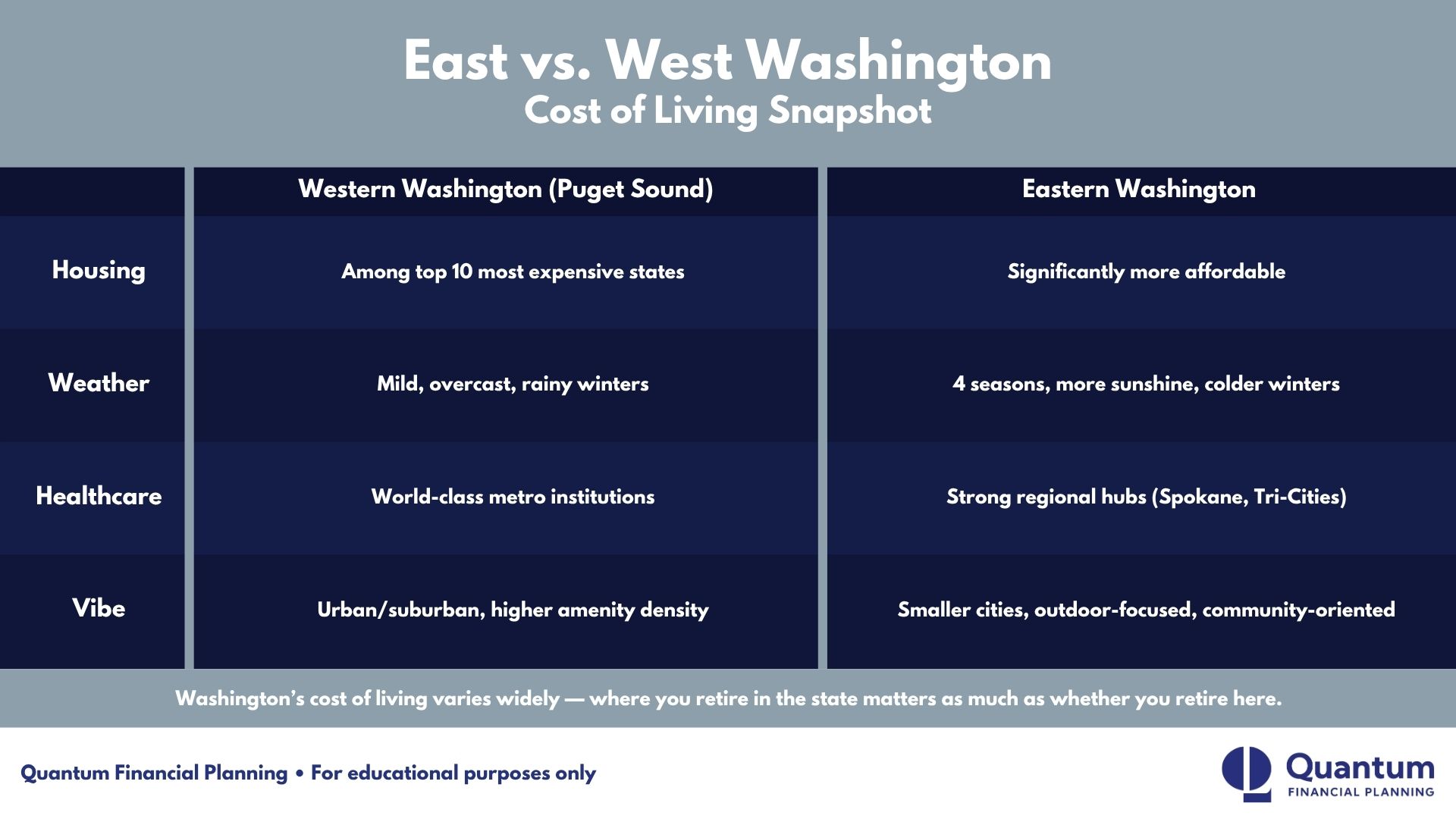
Many parts of Washington experience four distinct and beautiful seasons. While western cities like Seattle typically have milder, wetter weather, Eastern Washington and mountain communities see colder winters, more sunshine, and greater seasonal swings.
Although Washington residents can experience wildfires in the summer and an occasional earthquake, the state avoids many of the more severe natural disasters seen elsewhere.
Active Lifestyle
Washington is widely considered one of the most active states in the nation. Beautiful hiking trails, ski mountains, and lakes draw folks outside and public parks and a sports-loving culture keep people moving, which improves quality of life for many residents.
For most Washingtonians, this holds true well into their retirement years.
In fact, the United Health Foundation’s most recent Senior Report ranked Washington the #3 healthiest state for residents 65 and older.
Cons of Retiring in Washington State
High Housing Prices in Certain Areas
Although most of Washington doesn’t rival the cost of living in places like California, the Seattle–Tacoma–Bellevue region is often listed as one of the most expensive metro areas in the United States. As a result, Washington’s median home price is elevated, consistently placing it among the five most expensive states in the country.
Estate Tax and Capital Gains Tax
While Washington has not historically taxed earned income or retirement distributions, there are a few tax hurdles for Washington retirees to be conscious of.
The Washington estate tax is one of the most aggressive “death taxes” in the country, which can disrupt your legacy planning goals and impact your heirs if you aren’t proactive
In addition, Washington has two recently implemented taxes that impact high net worth families: the state capital gains tax and the “Millionaire’s Tax”.
Gray Skies and Rain in Western WA
While the Puget Sound and Cascade Mountains are beautiful backdrops when the sun is out, western Washington does experience its fair share of gray skies and heavy rainfall.
While it sets the stage for cozy mornings by the fire, the persistent gray skies can feel monotonous for some.
Winter Travel
The Snoqualmie Pass, situated between Ellensburg and North Bend, is the primary corridor between the east and west sides of the state and is infamous among locals for blockages, closures, and rough driving conditions in the winter months.
Mountain towns (such as the Bavarian-inspired gem Leavenworth) are known for the heavy snowfall they get each year, but they’re not the only ones. Other pockets of the state, such as Spokane County, get their fair share, which can make getting around during the winter months a bit cumbersome.
Transits & Commutes
Outside of the Seattle–Tacoma metro area, public transit is limited. Most of Washington is car-dependent, which is worth factoring into long-term retirement planning, particularly for retirees who may eventually need to rely on others for transportation. Even in midsize cities like Spokane, Yakima, or Tri-Cities, getting around without a car takes planning. It’s a practical consideration that doesn’t always come up in retirement conversations until it matters.
For those considering a retirement community, either independent or assisted, be sure to ask about their transportation offerings. Many senior living communities offer convenient shuttles or chauffeurs.
Wildfire Risks
Fortunately, Washington is protected from some of the severe natural disasters experienced elsewhere in the country such as hurricanes, tornadoes, and droughts.
However, large stretches of forest and farmland in eastern and central Washington can heighten wildfire risk during hot summer months.
Cost of Living and Taxes in Retirement
Comparing Washington to National Averages
According to World Population Review (WPR), Washington ranks in the top ten highest cost of living states. WPR also ranks Washington as the third highest state by average annual income and a top ten state economy.
All in all, Washington offers a quality of life that is near the best in the nation, but that comes with a price tag that isn’t cheap: a cost of living 10-25% higher than national averages.
Regional Differences Within Washington State
It’s worth noting, however, that cost of living varies widely within the state. Cities like Seattle, Bellevue, Kirkland, and other suburbs make the Puget Sound region one of the most expensive in the nation while areas like Spokane, Yakima, and Vancouver are far more affordable.
Sales Tax
Sales tax adds another layer to Washington’s cost picture. The statewide base rate is 6.5%, but local rates push the combined total to 10% or above in many cities, including Seattle and most of the Puget Sound region. For retirees on a fixed income, that percentage adds up on everyday purchases throughout the year. It’s one reason the overall cost of living in western Washington reads higher than the income tax savings alone might suggest.
Property Taxes and Senior Exemptions
While Washington’s tax landscape is complex and requires attentive planning, property tax is one area where the evergreen state offers seniors some relief.
Qualifying seniors in Washington state can receive a property tax exemption if they meet certain criteria.
Eligibility is based on age and household income, with thresholds that vary by county. For more detailed information and current exemption thresholds, visit the WA Department of Revenue website.
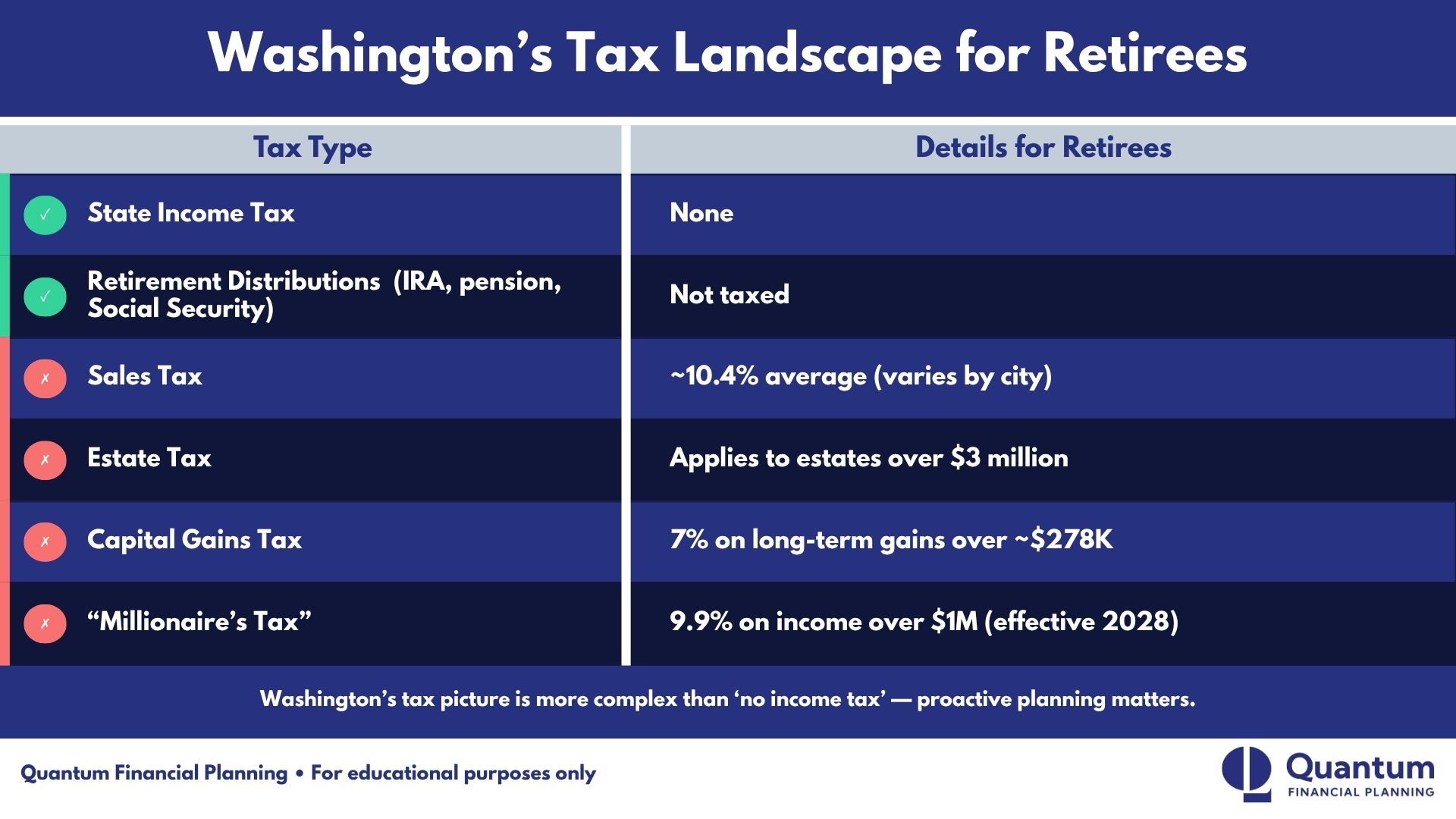
The Washington Tax Stack – Estate, Capital Gains, and Millionaire’s Taxes
Washington has no state income tax for most residents, but there are a few taxes that affect high net worth retirees.
Washington Estate Tax
Those considering retirement in Washington should consider the estate tax when planning for their heirs. Washington’s estate tax is one of the more aggressive “death taxes” in the nation.
If you’ve accumulated over $3 million in net worth, you’d benefit from proactive estate planning to help reduce the impact of Washington’s estate tax on what your loved ones may receive when you pass.
Washington Capital Gains Tax
For those who’ve built a portfolio of investments, the Washington tax on long-term capital gains is a hurdle to be aware of.
In addition to the federal capital gains tax, Washington investors with gains over the exemption threshold face additional taxes from 7%.
Washington “Millionaire’s” Tax
While Washington has historically been an income tax-free state, lawmakers recently passed into law a tax on income over $1 million in a given year; dubbed the “Millionaire’s Tax”. This is expected to be effective starting in the 2028 tax year.
Best Places to Retire in Washington State
Spokane
Overview & Location Spokane is a regional hub in Eastern Washington along the Spokane River, near the Idaho border. It combines city-level amenities – a growing downtown, strong arts and dining scene, established neighborhoods with housing costs well below the Puget Sound side of the state. For retirees who want a real city without the Seattle price tag (or traffic), it’s the clearest value in Washington.
Key Benefits
- Affordability: Housing and overall living costs run well below Puget Sound markets, giving retirees more room to work with in retirement income planning.
- Healthcare: Major hospital systems anchor the city, and healthcare accounts for nearly 20% of the regional economy. Spokane serves as the medical hub for a large portion of eastern Washington.
- Outdoor Access: Lakes, trails, ski mountains, and golf are all within easy reach. Spokane also hosts Bloomsday, one of the nation’s largest road races, and Hoopfest, the world’s largest 3-on-3 basketball tournament.
Potential Drawbacks
- Colder winters and drier summers than western Washington
- Reaching major national airports requires a connecting flight
- Fewer specialty medical facilities than Seattle
Financial Planning Considerations Lower housing and living costs create more flexibility in managing retirement income. Healthcare is solid regionally, but specialty care may occasionally require travel. For retirees comfortable with four seasons and looking to get the most out of their retirement budget without sacrificing lifestyle, Spokane makes a strong case.
Gig Harbor
Overview & Location Gig Harbor sits on the Puget Sound about 20 minutes from Tacoma and just over an hour from Seattle. Known for its scenic harbor, walkable waterfront, and boutique downtown, it offers a quieter pace without cutting ties to the broader Puget Sound region.
Key Benefits
- Waterfront Lifestyle: Boating, kayaking, and waterfront dining with harbor views. The downtown is walkable and hosts farmers markets, festivals, and local arts events throughout the year. Sailors can charter a boat for a day trip or overnight on the water.
- Access: About 30 miles from Sea-Tac Airport, with world-class healthcare and major amenities available in Tacoma and Seattle.
- Community Feel: Small-town atmosphere with a genuine local identity – without the isolation that comes with more remote towns.
Potential Drawbacks
- Above-average housing costs relative to surrounding communities
- Bridge and I-5 traffic toward Tacoma and Seattle can be significant during peak hours
Financial Planning Considerations Housing in Gig Harbor costs more than many cities on this list, though it stays below many Seattle-area suburbs. Proximity to Tacoma and Seattle provides access to diverse healthcare providers, affordable travel, and part-time work opportunities without the expense of big-city living. Coastal homeowners should also budget for moisture and salt-related maintenance over time.
Olympia
Overview & Location Washington’s capital sits at the southern end of Puget Sound with a compact, walkable downtown, waterfront access, and a civic culture shaped by its role as the seat of state government. It offers a real city feel at a cost of living well below Seattle.
Key Benefits
- Affordability: Housing and day-to-day costs run noticeably lower than Puget Sound metro areas, giving retirees more breathing room in their budget.
- Community: Farmers markets, local events, and a strong sense of civic engagement make it easy to stay socially connected. Downtown’s waterfront and nearby parks add to daily livability.
- Convenience: Access to healthcare, shopping, and everyday services without Seattle’s scale or congestion.
Potential Drawbacks
- Smaller dining, entertainment, and cultural scene than larger cities
- Typical western Washington winters: gray, overcast, and rainy
Financial Planning Considerations Olympia’s lower cost of living creates flexibility for healthcare, travel, and other retirement priorities. For retirees who want to stay cost-conscious without giving up access to services and community, it strikes a practical balance.
Wenatchee
Overview & Location Wenatchee sits along the Columbia River in North Central Washington, known as the “Apple Capital of the World.” It gets around 300 sunny days per year – far more than western Washington – and offers a quieter, outdoor-focused lifestyle with genuine small-city infrastructure.
Key Benefits
- Sunshine: The driest, sunniest location on this list, making year-round outdoor activity significantly more accessible than most of western Washington.
- Outdoor Recreation: Hiking, biking, golf, and easy access to winter sports at Mission Ridge and nearby Leavenworth. The Columbia River and surrounding lakes round out the options.
- Affordability: Housing and overall costs run well below Puget Sound markets, with a solid regional healthcare presence for core needs.
Potential Drawbacks
- Fewer specialty healthcare options and less variety in shopping and dining than larger cities
- Travel to western Washington requires crossing mountain passes, which can be affected by winter conditions
Financial Planning Considerations Lower housing and living costs may create more flexibility in retirement income planning. Specialty medical care could occasionally require travel to Seattle or Spokane, so building that into long-term healthcare planning is worth doing early.
Port Townsend
Overview & Location Port Townsend sits on the northeastern tip of the Olympic Peninsula with well-preserved Victorian architecture and a coastal setting. It’s one of Washington’s more distinctive small towns — genuinely artsy, walkable, and unhurried — and draws retirees looking for character and community over convenience.
Key Benefits
- Arts & Culture: Galleries, music festivals, and community events run year-round, supported by a strong local arts identity and an engaged, creative community.
- Mild Weather: The Olympic Peninsula’s location provides relatively mild temperatures compared to many inland areas.
- Small-Town Character: Walkable streets, a historic downtown, and a close-knit feel that’s increasingly rare in more developed areas.
Potential Drawbacks
- Specialized healthcare, major shopping, and airports all require travel outside the immediate area
- Limited housing inventory can affect timing and options
Financial Planning Considerations Housing costs in Port Townsend vary by property type and location, so it’s worth thinking carefully about how it fits the broader plan. The more important planning consideration is access – particularly for healthcare as needs evolve. Building in flexibility for travel costs, in-home care, or a potential future move gives the plan room to adapt.
Sequim
Overview & Location Sequim sits in a rain shadow on the northern edge of the Olympic Peninsula, receiving around 16 inches of rain per year compared to Seattle’s 38. That unusual microclimate, combined with proximity to Olympic National Park and a large, established retiree community, has made it one of the better-known retirement destinations in the state.
Key Benefits
- Climate: The driest spot in western Washington by a wide margin — significantly more sunshine than surrounding areas and a genuine quality-of-life difference for retirees who want to be outside. (There’s a reason the town’s nickname is “Sunny Sequim”!)
- Retiree Community: A large, established retiree population means strong social infrastructure, community programming, and services oriented toward older residents.
- Nature Access: Lavender farms, hiking trails, water access, and Olympic National Park all within easy reach.
Potential Drawbacks
- Dining, shopping, and entertainment are limited locally
- Specialized healthcare and major airports require travel; Port Angeles and the ferry to Seattle help, but access takes planning
Financial Planning Considerations Sequim offers manageable living costs compared to larger metro areas. The key planning focus is logistics — healthcare access and transportation over time. Making sure the plan has room for those needs, especially as circumstances change, is the most important consideration here.
Federal Way
Overview & Location Federal Way is a suburban city along I-5, positioned between Seattle and Tacoma on the Puget Sound corridor. It doesn’t have the small-town charm of other cities on this list, but its location gives retirees straightforward access to two major metro areas, Sea-Tac Airport, and the healthcare systems of both cities.
Key Benefits
- Location: Easy reach of Seattle, Tacoma, and Sea-Tac Airport — practical for retirees who travel often or have family across the region.
- Healthcare Access: Proximity to major hospital systems in both Seattle and Tacoma without the cost of living in either city.
- Relative Affordability: Housing prices generally run more accessible than Seattle proper while staying within the Puget Sound region.
Potential Drawbacks
- Suburban layout with limited walkability and no defined downtown
- I-5 traffic is significant, particularly during peak commute hours
Financial Planning Considerations Federal Way is a pragmatic choice for retirees who want to stay in the Puget Sound region while keeping costs more manageable. Proximity to major healthcare and transportation adds long-term flexibility. The main question is whether a suburban, car-dependent setting fits your lifestyle — for those it does, Federal Way is a solid and well-connected option.
How to Choose the Right Retirement Location
Factors to Consider
Proximity to Family
All the financial considerations of choosing a place to retire likely pale in comparison to what is most important for the majority of retirees: family and friends.
While certain things might be harder or more expensive if you choose to retire in a city like Federal Way or Gig Harbor, it might very well be worth it if that’s where your kids or grandkids have landed.
Healthcare Access
Proximity to quality medical centers is one important consideration, but so is access to and quality of other care that is important as you age. Finding a primary care physician and network of specialists near you can go a long way in making some of the inconveniences of aging slightly less inconvenient.
Independent and assisted senior living options may not be a consideration now, but planning flexibly for the long-term is essential.
Climate and Lifestyle
Do you like warm, sunny weather and want to sit by the pool all summer long? Does snow intimidate you? Or would you prefer a full four seasons with vibrant springs and colorful tree-lined autumns?
Thanks in part to its mild climate, Washington’s culture is a fairly active one. From hiking, biking, and walking trails to lakes, golf courses, and recreational sports, Washington offers retirees a chance to enjoy retirement while staying engaged.
Cost
Finally, while cost shouldn’t drive the whole decision on where to retire, it’s an important factor to consider, as costs vary widely from state to state and even city to city.
Retirees relocating from a state like California, for example, might find Washington comfortably affordable while maintaining (or even improving) their lifestyle. The same likely can’t be said for retirees moving from a less expensive region like the south or midwest.
Regardless of whether you’re relocating to Washington or have lived there your whole life, transitioning to retirement brings new considerations to talk with your financial planner about.
Small Towns vs. Urban Areas
A classic tradeoff that is not unique to Washington retirees: big city or small town? While some folks have an immediate and visceral response to this one way or another, there are valid pros and cons to consider.
Fortunately, Washington has its fair share of both.
Among the picturesque small towns with plenty of charm are Walla Walla, Port Townsend and Anacortes.
More urban options include the Seattle-Bellevue region as well as Spokane, the second largest metro area in the state.
A Question to Ask Yourself – Do I want to age in place or move into a senior community?
Retirement looks unique for each person. And countless factors might weigh into your decision of where to retire. One factor to consider is where you see yourself spending your later retirement years.
Aging in place in a home you own has plenty of benefits: independence, familiarity, and a place to comfortably host visiting family and friends to name a few.
That said, for some retirees—especially those with children or grandchildren living out of state—the challenges of homeownership, including maintenance, isolation, and limited community, can begin to outweigh the benefits. In these cases, independent senior living communities can offer a more convenient, connected, and fulfilling retirement lifestyle.
Like most financial planning decisions, this one is fluid and can change, so building a plan that is flexible and can adapt alongside you is often the way to go.
Consider a “Test Drive”
Before you start calling a moving company to pack up the baby grand piano in your living room, consider “test driving” a city (or multiple towns) you’re considering for a period of time.
In today’s day and age, sites like AirBnB and VRBO offer plenty of ways to stay in a city and live like a local at a reasonable cost.
Moving is not a fun process, regardless of stage of life, so feel free to start with a thoughtful vacation to see if that place you want to move to is all it’s cracked up to be.
Healthcare Access and Retirement Living in Washington
Where to Find Washington’s Best Hospitals and Long-Term Care Facilities
When it comes to top-tier hospitals and medical centers, the bustling Puget Sound region has an advantage. The Seattle-Bellevue-Tacoma region boasts an impressive number of world-class medical institutions, such as theVirginia Mason Medical Centerand the University of Washington Medical Center.
Outside of the western part of the state, other hubs like Spokane and Tri-Cities offer plenty of quality hospitals and healthcare options as well.

The Rural Healthcare Tradeoff
If you’re looking for a small-town retirement, you’ll want to do some research on healthcare in your desired area. Some areas throughout central and eastern Washington are geographically isolated and may only offer some of what you need in the immediate area.
If you see a specialist regularly or have a limited insurance network, there’s a chance you’ll have to make a trek to a larger hub for more expansive options.
Retirement Communities and Aging-In-Place Support
Another important healthcare consideration is long-term care. Whether you’re planning on aging in place for as long as you can or hoping to move to a resort-style independent living community ASAP, Washington provides plenty of senior living options ranging from independent to assisted and even more acute memory care.
AARP’s most recent scorecard ranked Washington #2 in the nation for long-term services and support — with specific recognition for the state’s work on innovation and expanding access for aging adults. The full scorecard is available here.
Where Washington Ranks Nationally for Healthcare
Washington is consistently ranked in top ten lists for healthcare systems, infrastructure, and resources. The Commonwealth Fund recently ranked Washington #9 overall for health system performance, which attempts to determine how well the healthcare system is working for people in each state.
Lifestyle and Recreation Opportunities
Outdoor Recreation Across Washington State
An active lifestyle is a trademark of a Washington state retirement. Outdoor enthusiasts can enjoy hiking (or skiing) the Cascade Mountains, fishing (or simply going for a walk alongside) the Columbia River, or visiting one of the over 8,000 lakes or reservoirs throughout the state.
The Pacific Northwest’s active culture extends beyond nature into other activities as well. Bainbridge Island is the birthplace of pickleball. Spokane hosts one of the largest road races in the nation and the largest 3-on-3 basketball tournament in the world every year.
Need more proof of Washington’s sporty culture? Look no further than the Washington State Senior Games, where those 55 and older compete in an Olympics-style event with sports ranging from archery to race walking, badminton, rock climbing, and many more.
Whether you won’t be caught on a couch for longer than 15 minutes and need a state that keeps up with you or you just want a beautiful lakeside beach to park a chair on and read a book, Washington has something to offer.
Cultural and Community Offerings
Washington also offers plenty of cultural and community opportunities for retirees. From museums, art walks, and live music to seasonal festivals, county fairs, and farmers markets, many cities and towns across the state make it easy to stay engaged year-round.
Whether you prefer larger cultural hubs like Seattle that host world-class events or smaller community-focused areas like Spokane, Vancouver, or the Tri-Cities, retirees can find local events, social activities, and gathering spaces that support an active and connected lifestyle.
Ease of Travel
Despite occasional winter weather challenges, Washington offers strong travel accessibility for retirees. In addition to Seattle‑Tacoma International Airport (Sea‑Tac), the state is served by a network of regional airports, making it easy to reach major U.S. destinations or connect internationally.
Whether you’re escaping to Hawaii, heading to Arizona for the winter months, or just wanting a quick flight across the state so you don’t have to drive 5 hours, you’ll have options.
FAQ: Retiring in Washington
These are the questions we hear most from clients thinking through retirement in Washington.
Does Washington tax retirement income?
No. Retirement income such as IRA withdrawals or pension income is not subject to income tax in Washington. Even for high earners subject to the Millionaire’s Tax, qualified retirement income is exempt.
What is the estate tax threshold in Washington?
As of July 1, 2026, the Washington estate tax exemption is $3,000,000 per person. Assets above this threshold at date of death may be taxed at tiered tax rates.
Though the state does not offer automatic portability, with proper planning, married couples can effectively use a combined exemption of $6,000,000 through the use of a credit shelter trust.
How does the cost of living vary across Washington?
The cost of living in Washington varies widely. Cities like Seattle, Bellevue, and other Puget Sound area suburbs are among the most expensive in the nation, while areas east of the Cascade Mountains, such as Yakima, Spokane, Tri-Cities, and Wenatchee, offer a much more affordable lifestyle.
Will the capital gains tax impact retirees?
It might. Retirees are not exempt from the Washington state capital gains tax. However, the threshold is quite high.
Only a small percentage of Washington residents are expected to be subject to the tax as long-term capital gains must surpass at least $278,000 in a single tax year and there are several exemptions, such as for real estate and small businesses.
Is access to quality healthcare consistent throughout the state?
While there are quality medical centers and healthcare resources throughout the state, some regions lead the pack. Seattle, as the state’s largest city and transportation hub, has the most impressive lineup of healthcare programs and facilities. On the eastern side of the state, Spokane–where healthcare accounts for almost 20% of the region’s jobs–has several major hospitals and strong medical infrastructure.
If you land in one of Washington’s many rural gems, however, you may want to consider where the region’s nearest medical hubs are.
Do seniors qualify for property tax exemptions?
Yes. Washington offers a property tax exemption for seniors and people with disabilities. The exemption is income-based and the threshold is set at the county level.
For more information and current county-by-county income thresholds, see the WA DOR’s website.
Does Washington support long-term care and aging in place?
Yes. Washington is one of the better-resourced states in the country for long-term care. AARP ranked it #2 nationally for long-term services and support, recognizing the state’s infrastructure for both home-based and facility-based care. Independent and assisted living communities are available throughout the state, with higher concentrations around the Puget Sound region and Spokane.
For those who prefer to stay at home, community-based programs and in-home care services are widely available to support aging in place. Long-term care costs and coverage options are worth discussing with your financial advisor well before you anticipate needing them.
Which Washington cities are best for affordability?
If you’re looking for a smaller town feel, eastern and central Washington offer plenty of cost-effective options such as Yakima, Wenatchee, or Tri-Cities.
Vancouver and Spokane offer a lot of the amenities of a bigger city while still being quite affordable compared to both state and national averages.
We Can Help You Retire in Washington
Washington offers a genuinely compelling case for retirement: no income tax on retirement income, world-class healthcare infrastructure, remarkable natural beauty, and a quality of life that consistently ranks among the best in the nation.
But it’s not a simple story. The estate tax, capital gains tax, and Millionaire’s Tax create real planning considerations for higher-net-worth retirees. The cost of living, particularly in the Puget Sound region, requires honest budgeting. And whether Spokane, Gig Harbor, Sequim, or somewhere else entirely is the right fit depends entirely on your priorities.
That’s where proactive financial planning comes in. The good news: most of the challenges Washington presents to retirees are addressable with the right strategy in place. From structuring your estate to minimize tax exposure to building a retirement income plan that accounts for regional cost differences, the decisions you make before and during the transition to retirement have a real impact on the life you get to live.
Working with a fiduciary financial advisor who understands Washington’s specific tax landscape — and who doesn’t earn commissions on the products they recommend — gives you an objective partner for navigating these trade-offs.
If you’re considering retiring in Washington and want to build a plan that accounts for your specific goals, family situation, and financial picture, book a call with our team. We’d love to help.