

- One notable tax benefit of inheriting a home is the step-up in basis. Instead of using the home’s original purchase price, tax basis is generally reset to its fair market value on the date of the owner’s death.
- Before deciding whether to sell, keep, or rent an inherited home, confirm ownership, establish its date-of-death value, and gather the right documentation. Doing so can help reduce costly mistakes and make future tax reporting easier.
- Washington doesn’t tax the sale of real estate under its state capital gains tax, but federal capital gains tax rules may still apply. Understanding the difference may help you make more informed decisions about an inherited home.
If you’re inheriting a house in Washington, you’re probably trying to make sense of a lot at once.
Along with the legal and practical decisions that come after a loss, you’re sorting through paperwork, family conversations, and figuring out what to do with the home.
You may be wondering whether to keep it, sell it, or turn it into a rental.
And then come the questions about taxes:
- Will you owe taxes if you sell?
- How is the home’s value determined? And how does the step up in basis work?
- What should you do before making any big decisions?
- Will making it a rental property give me tax write-offs?
The good news is that inheriting a house doesn’t automatically mean you’ll receive a tax bill. But the choices you make afterward could affect your finances for years to come.
Much of what happens next depends on three things:
1. How ownership of the home transfers to you,
2. The value the IRS assigns to the property when you inherit it, and
3. What you decide to do with it afterward.
Understanding how these pieces fit together may help you feel more confident about what to do with the property. Of the three, the home’s value when you inherit it often has the greatest impact on the taxes you may owe later.
One tax rule, called the step-up in basis, plays an especially important role.
Don’t worry if you’ve never heard the term before. We’ll explain what it means, why it matters, and how it can affect the taxes you may owe if you eventually sell an inherited home.
We’ll also answer some common questions families have after inheriting a house in Washington, including what happens if you sell an inherited home, what changes if you decide to keep it, and what makes Washington’s capital gains tax rules different from those in other states.
If You Inherit a House: The First Tax Facts Heirs Need to Know
If you decide to sell an inherited house, one of the first questions you’re likely to ask is, “Will I have to pay taxes?”
If the answer is yes, the next question is just as important: What are those taxes based on?
Is it the price your grandparents paid for the home decades ago? What the home was worth when you inherited it? Or what you eventually sell it for?
Let’s take a look at an example:
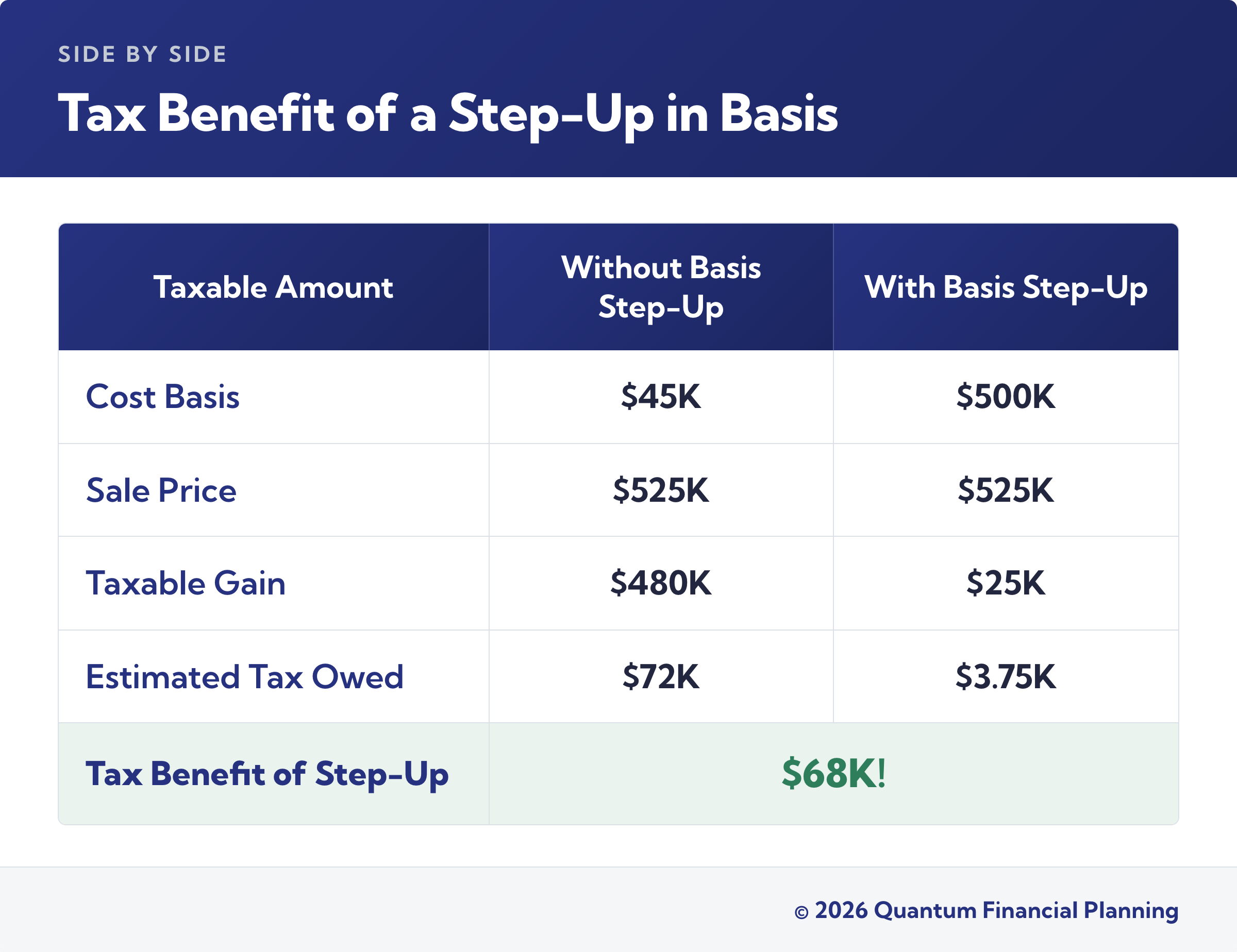
Say your grandparents bought a home in Spokane in 1970 for $45,000. By the time your grandmother passed away in 2026, the home was worth $500,000.
You inherit the house and decide to sell it for $525,000 a year later. So which number determines how much tax you’ll pay?
The answer is $500,000. Why? A federal tax rule called a step-up in basis.
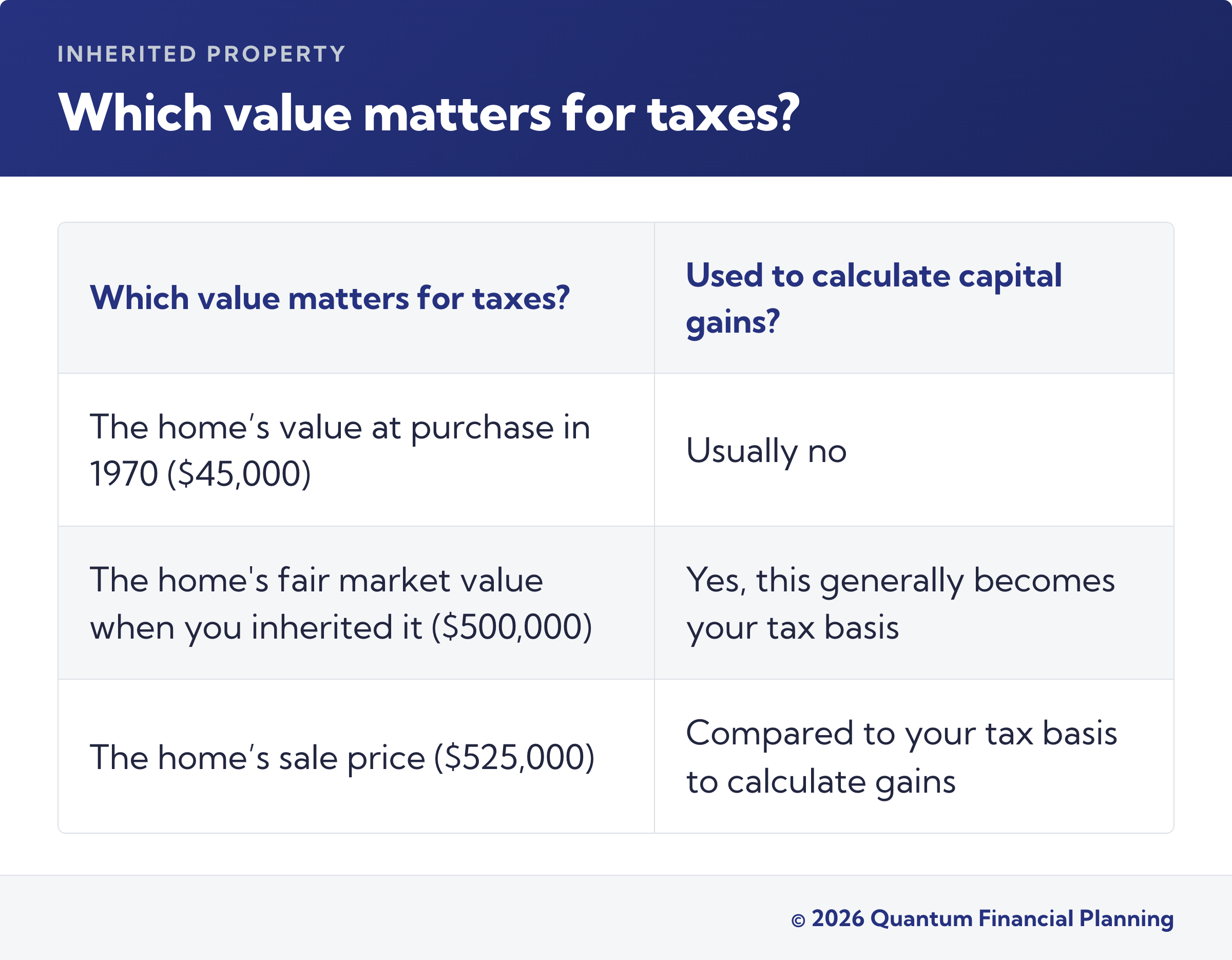
Instead of using the $45,000 your grandparents originally paid for the home, the IRS resets the starting value to what the home was worth when you inherited it.
The IRS has a name for that starting value: your tax basis (sometimes called your cost basis). When you sell the home, the IRS compares your tax basis to the sale price to determine whether you’ve made a taxable gain (also called a capital gain) when you sold it.
In our example, your tax basis would be $500,000. If you sell the home for $525,000, the difference—$25,000—is your capital gain.
Your tax situation will determine if that gain is subject to capital gains tax.
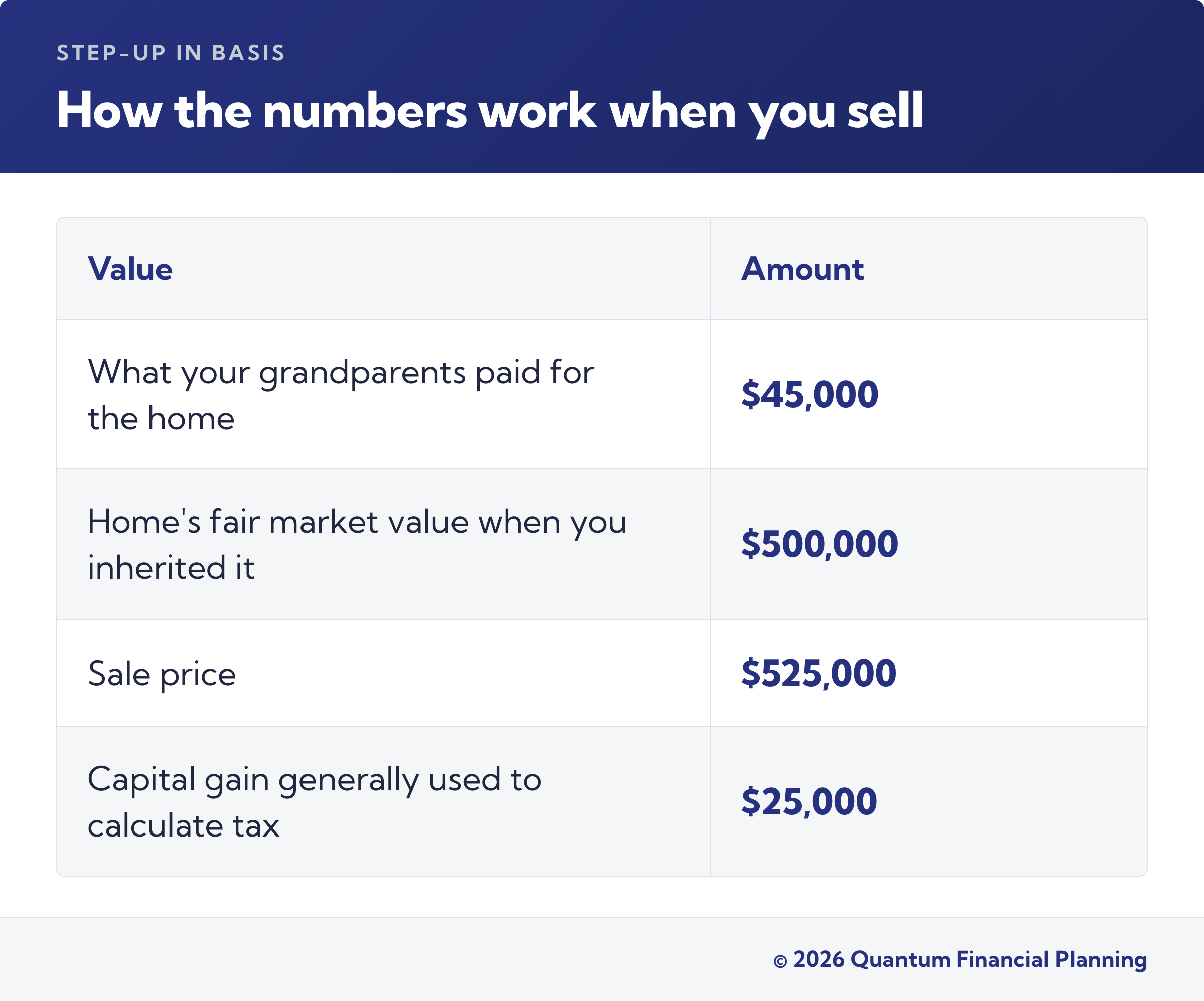
Why does this matter? Without the step-up in basis, your capital gain could have been calculated using your grandparents’ original $45,000 purchase price, resulting in a much higher tax bill.
Instead, the step-up in basis means you get to start with the home’s value when you inherited it. If you’re inheriting a house in Washington that’s been in your family for decades, this rule can help lower the amount of capital gains tax you may owe if you decide to sell.
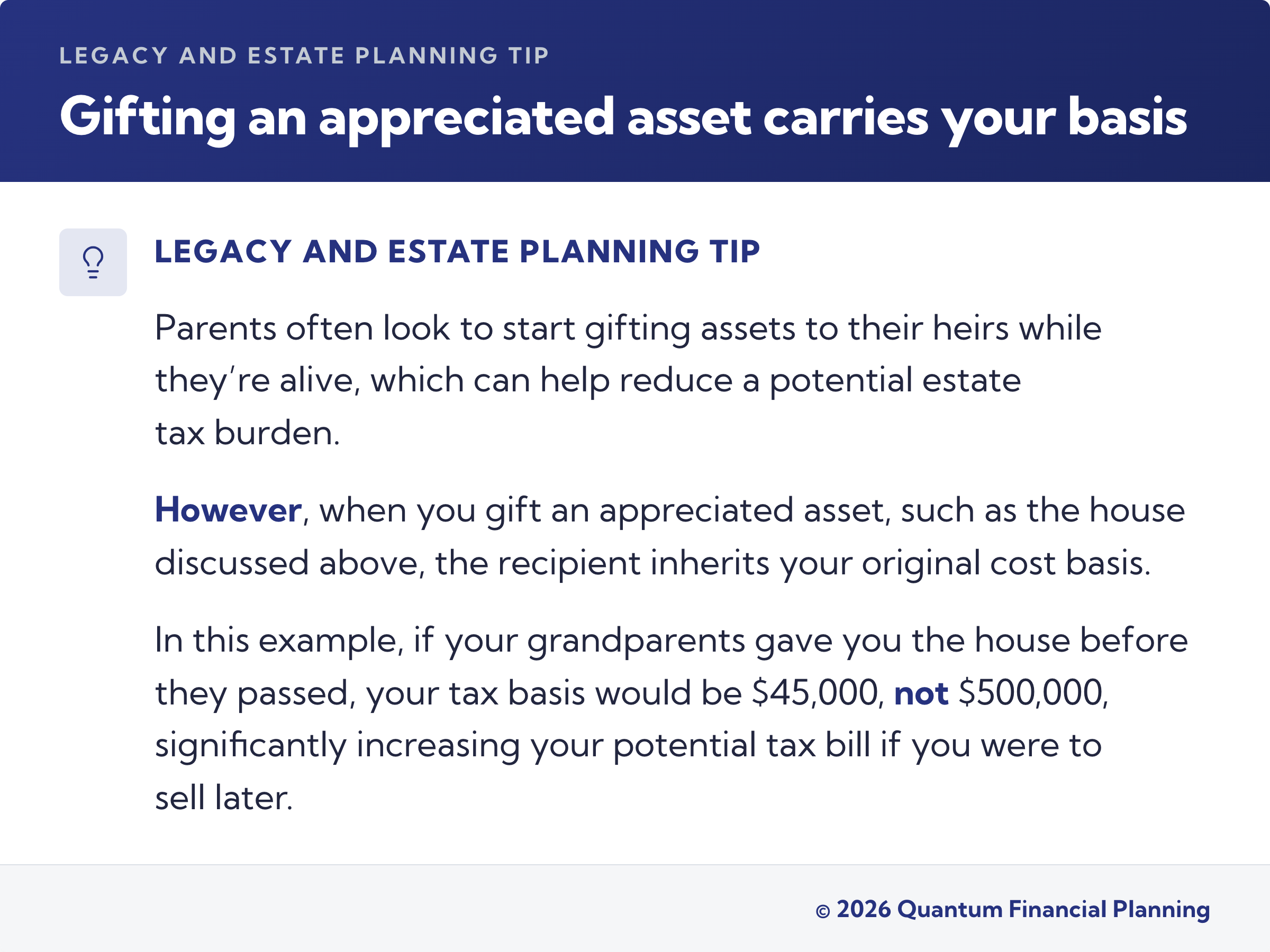
One final point is worth keeping in mind: not every inherited asset is treated the same way for tax purposes.
An inherited house and an inherited brokerage account often receive a step-up in basis, while inherited retirement accounts, such as traditional IRAs and 401(k)s, typically follow different tax rules.
What Heirs Actually Inherit and How the Property Passes to Them
When you inherit a home, it doesn’t become yours right away.
First, ownership has to legally pass to you.
Exactly how ownership passes to you depends on how the home was titled — for example, as sole ownership, joint tenancy, community property, or held in a trust — and whether the deceased owner had a will, trust, or other estate planning documents in place.
That’s why confirming title is one of the first practical steps to take after a homeowner dies. Doing so tells you whether ownership has already transferred to you or whether additional steps are still needed before you can legally take ownership of your inherited property.
Probate vs. Non-Probate Transfers
So how does a home legally change owners after someone dies?
One common path is probate—a court-supervised process of settling a person’s estate, paying any outstanding debts, and transferring assets, including real estate, to the appropriate heirs or beneficiaries.
Probate isn’t the only way ownership can transfer, though.
Depending on how the home was titled, it may go directly to a surviving spouse or co-owner, be distributed through a trust, including community property trusts, an estate planning tool some Washington couples use, or pass automatically to a beneficiary through a transfer-on-death (TOD) deed.
Case Study: When it Makes Sense Not to Transfer an Inherited House Into Your Name
For married couples in Washington, bypass trusts (aka credit shelter trusts or disclaimer trusts) are a common planning tool to reduce estate taxes by maximizing each spouse’s estate tax exemption. Here’s an example of how the use of a bypass trust might change things.
Scott and Heather are a married couple in Washington state with a total net worth of $7 Million and had just recently bought their dream house near their grandkids for $1.2M. Scott unexpectedly passes away two years later. The real estate ebbed and flowed and the home was worth $1.1M at his date of death.
Because of that, Heather and her attorney decided to place the house in the trust and not in Heather’s name personally, and forgo the potential second step-up in basis at her death in the future. By doing so, the house (and any future increase in value) is removed from Heather’s taxable estate when she passes.
Contrast that with a highly appreciated joint brokerage account, where Scott and Heather owned growth stocks worth $1.5 million and a cost basis of only $500K. By keeping this in Heather’s name, she gets a $1M step up in basis now and preserves the opportunity for a second step up in basis at her death if the account continues to grow aggressively. The brokerage account will however be included in her taxable estate when she passes.
Once you’ve determined the home is legally yours, the next question is how it’s treated for tax purposes.
Inheriting a House: Tax Implications of Step-Up in Basis
As discussed above, when you inherit ownership of a home, you don’t automatically inherit the previous owner’s tax situation. Instead, inherited property follows its own set of tax rules.
One notable tax benefit is called the step-up in basis.
Under this rule, the home’s tax basis is reset to its fair market value on the date of the owner’s death.
Put simply, tax basis is the number the IRS uses as a starting point to determine whether you owe taxes—and how much—if you sell the home later.
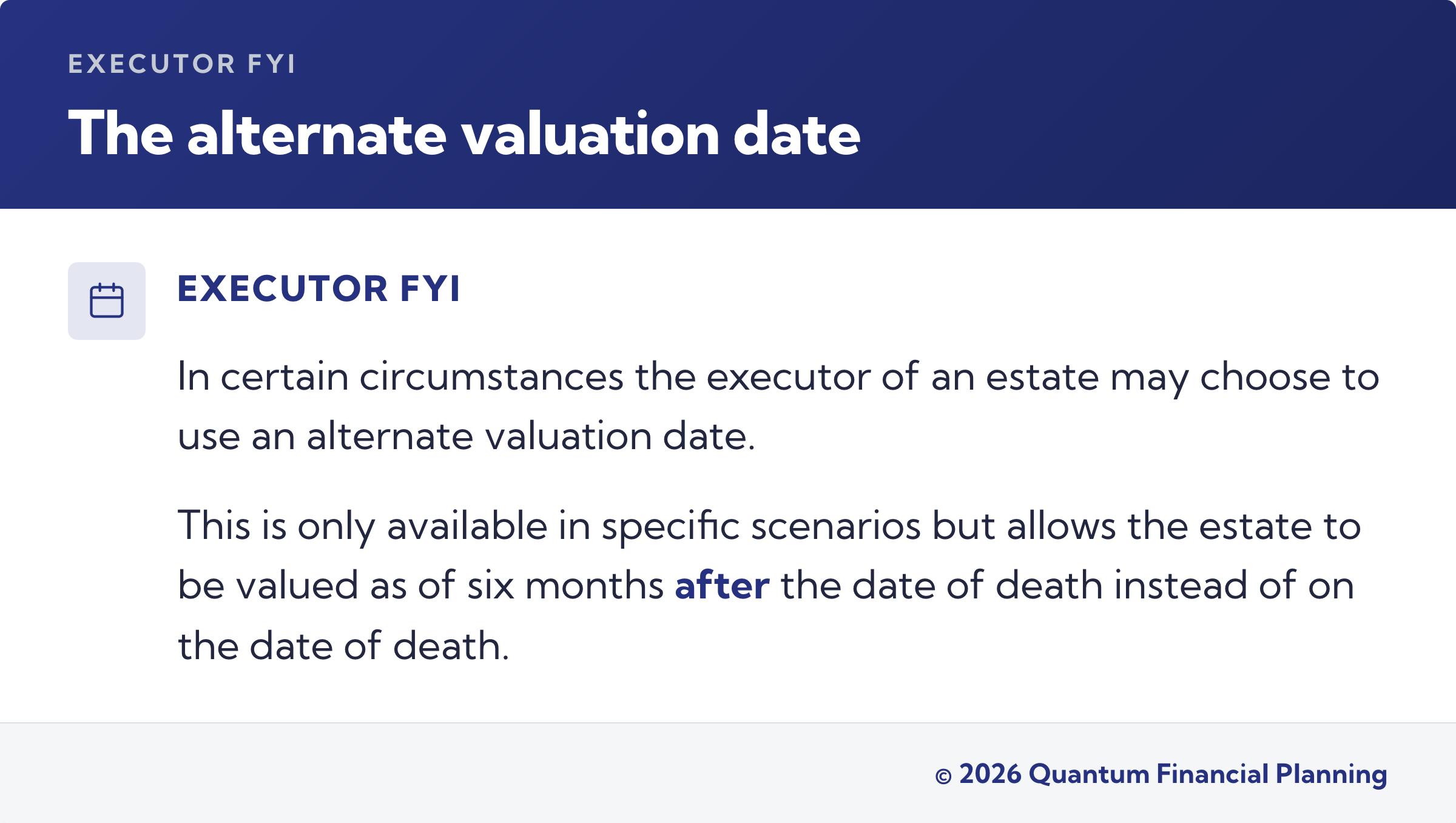
For most inherited homes, the home’s fair market value on the date of the owner’s death becomes the new tax basis. (In some estate situations, a different valuation date may be used.)
That means any taxes you end up paying are usually based on any increase in the home’s value after you inherit it, not before. For many families, that can mean meaningful tax savings—especially if the home is sold soon after inheritance.
The following example helps illustrate how it works.
Simple Example of a Basis Step-Up
Let’s go back to Grandma’s house in Spokane.
She and Grandpa purchased the house for $45,000 in 1970. On the day Grandma passed away, the home’s fair market value was $500,000. Because of the step-up in basis rule, that number is your new tax basis, not your grandparents’ original $45,000 purchase price.
Now imagine you inherit the home and sell it a year later for $525,000.
In this example, any taxes you’ll need to pay would be based on the $25,000 difference between the home’s fair market value when you inherited it and the sale price.
That’s where the tax savings come in.
For capital gains tax purposes, the amount the home’s value increased before you inherited it isn’t part of the equation. Instead, any taxes you owe are usually based only on how much it went up in the few months between when you inherited it and when you sold it.
How Date-of-Death Value Is Established
In Grandma’s example, we assumed the home was worth $500,000 when she passed away.
But where does that number—the date-of-death value—actually come from?
In most cases, it starts with determining an inherited home’s fair market value on the date of the owner’s death. This is what’s known as the date-of-death value.
That number becomes the home’s tax basis, which the IRS uses to help determine whether you owe capital gains tax—and how much—if you sell the property later.
Getting a professional appraisal is a common way to establish the date-of-death value.
The appraiser may look at sales of similar homes in the same neighborhood or local market around the date of the owner’s death. They’ll also consider factors that could have affected the home’s value at that time, such as its size, age, location, features, and overall condition.
Additional documentation may also help support the date-of-death value. That could include a broker price opinion (an estimate prepared by a real estate professional), comparable sales data, or other estate valuation records, such as probate or trust documents.
Even if you don’t plan to sell your inherited home right away, it’s wise to document the date-of-death value as soon as practical after the owner dies—and before making major changes to the property.
The longer you wait, the harder it may be to reconstruct what the home and the local market were like on that date.
Reliable documentation also gives you a defensible tax basis if you sell the home years later.
Without it, you may have a harder time supporting the value used to calculate your capital gains tax, which could lead to paying more tax than necessary or having to answer additional questions from the IRS.
Client Case Study: The Value of a Date-of-Death Appraisal
A married couple came to Quantum while preparing to sell a large parcel of undeveloped land they had inherited years earlier. Because years had passed since the previous owner’s death, they were using the county tax-assessed value at the date of death as the property’s tax basis. However, tax-assessed values are often significantly lower than true market value and may not be appropriate for income tax reporting.
We helped the clients engage a qualified appraiser to determine the property’s fair market value as of the actual date of death. The appraisal established a substantially higher basis than the assessed value, which significantly reduced the taxable gain on the sale and lowered their tax bill by more than $40,000.
This real client case highlights the importance of obtaining a reliable date-of-death valuation for inherited assets. An accurate appraisal can help ensure beneficiaries receive the full benefit of the available basis step-up and avoid paying unnecessary taxes when inherited property is eventually sold.
Once you’ve established the home’s date-of-death value, you can begin comparing what happens under different scenarios. The simplest is selling the home soon after you inherit it.
If You Sell the Inherited Home Soon After Death
Selling soon after inheritance is often the simplest situation because the home’s value may not have changed much since the date-of-death valuation.
That often makes the tax calculation relatively straightforward. Because of the step-up in basis rule, the home’s date-of-death value becomes the comparison point for determining whether you owe capital gains tax.
Think back to Grandma’s house in Spokane. When you inherited it, the home’s fair market value was $500,000. A few months later, you sold it for $525,000.
In that example, any capital gains tax would generally be based on the $25,000 increase in value after you inherited the home—not on the decades of appreciation while your grandparents owned it.
Choosing to sell shortly after the owner’s death often means the tax impact is minimal because the home’s value may not have changed much between the date of death and the day you sell it.
In a fast-moving real estate market, though, prices can rise or fall quickly. The bigger the change in value up or down, the larger the potential capital gain—or loss—when you sell the home. For better or worse, those price fluctuations can meaningfully impact your tax situation.
Still, not everyone who inherits a home chooses to sell it right away. If you decide to keep the property instead, there are additional financial and tax considerations to think through.
What Changes If You Keep the House
Selling isn’t the right choice for every family. You may decide to keep an inherited home because you want to live in it, use it as a family home, or simply because you’re not ready to sell. Whatever the reason, keeping the home means shifting your focus from selling it to managing it.
Even if the mortgage has been paid off, you’ll still need to budget for ongoing expenses such as property taxes, homeowners insurance, utilities, routine maintenance, and unexpected repairs.
The way you choose to use the home matters, too.
Living in it yourself or converting it into a rental property are two very different decisions. Although both mean you’re holding on to the home, they can affect your finances—and your taxes—in different ways over time.
For now, the important thing to understand is that keeping an inherited home isn’t simply delaying the decision to sell.
Instead, it’s the beginning of a new set of decisions about how you’ll use the property in the years ahead.
Sell Soon After Death vs. Keep and Rent
After inheriting a home, many families find themselves weighing two common options: sell the property soon after inheritance or keep it as a rental.
Selling an inherited home relatively soon after the owner’s death is often the simpler path from a tax perspective and offers the heir(s) a lump sum that can be reinvested or deployed elsewhere..
As a reminder, the home’s tax basis (sometimes called its cost basis) is reset to the home’s fair market value on the date of death.
If the home’s value hasn’t changed much before it’s sold, there may be very little capital gain. As a result, your capital gains tax bill may be small—or you may not owe any tax at all—which is one of the biggest advantages of the step-up in basis rule.
Keeping the home as a rental also comes with ongoing recordkeeping and tax responsibilities. These may include tracking rental income, documenting expenses related to the property, and reporting rental activity on your tax return.
Ultimately, what you decide to do with an inherited home depends on your financial goals, your family’s needs, and whether you’re prepared for (or want to take on) the responsibilities of owning rental property.
If you’re unsure which direction to take, a financial professional can help you evaluate your options.
Improvements, Depreciation, and Later Basis Adjustments
It’s also important to keep in mind that certain decisions you make after inheriting the home can change your tax basis over time, beginning with any major improvements.
Some improvements can increase your tax basis because they add value to the home, extend its useful life, or adapt it for a new use. Examples include replacing the roof, remodeling a kitchen, building an accessory dwelling unit (ADU), or installing a new HVAC system.
Routine repairs and maintenance, such as painting, fixing a leaky faucet, replacing broken windows, or maintaining the landscaping, help preserve the home’s condition rather than add to its value. They typically don’t increase your tax basis, however they can typically be deducted from any rental income you receive.
Rental property owners may be able to claim depreciation, a tax deduction that recognizes the property’s wear and tear over time.
While depreciation can reduce your taxable rental income each year, it can also affect your taxes when you eventually sell the home. Keeping good records from the beginning can make it much easier to accurately calculate applicable taxes later.
If the inherited property had previously been used as a rental, it can be helpful to retain prior tax returns and depreciation records as part of the estate’s documentation. However, because inherited property generally gets a reset basis when ownership passes to the inheritor, past depreciation prior to date of death is unlikely to affect your taxes going forward
Inheriting Part of a House (With Siblings or Other Heirs)
It’s difficult enough to decide what to do with an inherited property when you’re the sole recipient of that property, but it gets even more complex when multiple heirs are named in the estate.
While most estates have a single executor named that is in charge of administering the estate according to the decedent’s wishes, it’s rare for an estate to pass to one singular person. This means most of these decisions require the coordination of multiple people, all of whom may be in different life stages, financial situations, and geographic regions.
Sometimes the decision becomes easy, such as when nobody is emotionally attached to the house and all heirs may agree to simply sell the house and split the net proceeds.
Other times however, the right decision isn’t so obvious. One or two heirs, for example, may want to keep the home in the family or keep it as a rental temporarily to think about it longer, while a third heir may need their portion of the inheritance for one reason or another.
In this situation the heir or heirs who wish to keep the house may be put in a position where they need to buy out their sibling(s) or co-heir(s). This can spur a unique real estate transaction and conversations should be had about the value of the home and whether or not the property must be bought at full fair market value or at a discount agreed upon by family members.
Washington-Specific Surprises Heirs Should Know
You may have heard that Washington has a state capital gains tax. That’s true.
But under current Washington Department of Revenue guidance, it doesn’t apply to the sale of real estate, including inherited homes.
The long-term capital gains tax does however apply to certain investments, including stocks.
That doesn’t necessarily mean you won’t owe taxes when you sell an inherited home. Federal capital gains tax rules can still apply.
In other words, if the home’s value goes up after you inherit it and then you decide to sell it, you may owe federal tax on the difference between its date-of-death value and the sale price.
It’s also worth distinguishing Washington’s capital gains tax from Washington’s separate estate tax. Washington’s estate tax applies to the estate itself, not to heirs directly, and only to taxable estates — those valued above the state’s estate tax exemption.
This is different from the federal estate tax exemption, which is currently much higher, so very few estates owe federal estate tax. If an estate’s value exceeds the applicable threshold, the executor typically needs to file an estate tax return before distributing assets to heirs.
Because the step-up rule already resets an inherited home’s basis, most families don’t face double taxation between estate tax and capital gains tax on the same increase in value.
Before selling an inherited home, it’s a good idea to talk with a financial or tax professional who can help you evaluate how the rules apply to your specific situation.
Inherited Investment Accounts vs Real Estate: What’s the Difference?
Many people assume all inherited financial accounts are taxed the same way. They’re not.
Like inherited real estate, investments held in inherited brokerage accounts receive a step-up in basis.
That means any taxes you owe when you sell those investments are typically based on how much they increased in value after you inherited them.
On the other hand, inherited retirement accounts such as traditional IRAs and 401(k)s have a different set of tax and withdrawal rules. They generally don’t receive a step-up in basis and in fact are taxed as ordinary income tax rates, which are less favorable than capital gains brackets..
For that reason, it’s important to consider retirement accounts separately from inherited homes and brokerage accounts when making tax and financial decisions.
Documentation Heirs Should Gather Before Making Decisions
Before you make any decisions about inherited property, make sure you have the right documentation in place. It might not be exciting, but it is essential.
Having complete records helps make tax reporting easier, prevents costly mistakes, and saves time and headaches if questions come up later.
The records you’ll need depend on the type of asset you inherited.
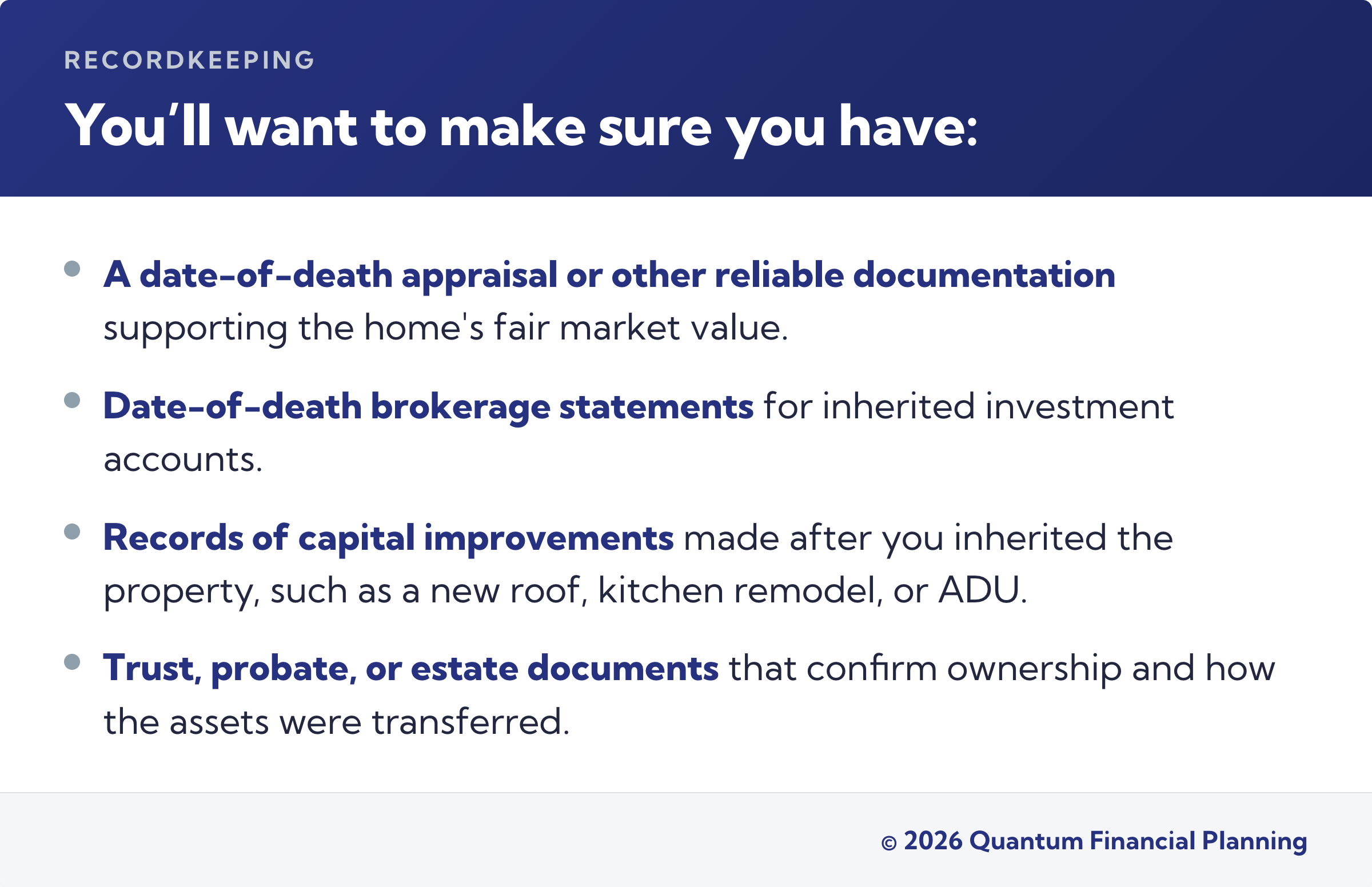
Keeping these records organized can help support accurate tax reporting and make it easier to work with your financial professional, CPA, or attorney when it’s time to sell, rent, or transfer inherited assets.
Common Mistakes Heirs Make After Inheriting Property
After losing a loved one, it’s not always easy to make big financial decisions.
Giving yourself the time and space to gather the right information before you sell, rent, or transfer inherited assets can help you avoid mistakes that may be difficult—or expensive—to fix later.
Some common mistakes include:
- Selling before establishing a reliable date-of-death value. Without good documentation of what the home was worth when you inherited it, calculating taxes later can become much more difficult.
- Assuming inherited assets are automatically tax-free. Inheriting property doesn’t always eliminate taxes. Taxes may still apply when you eventually sell the asset or withdraw money from inherited retirement accounts.
- Treating all inherited assets the same way. Different tax rules apply to homes, brokerage accounts, and retirement accounts. Understanding how those rules work can help you avoid costly tax surprises.
- Making major decisions without professional guidance. Selling an inherited home, liquidating inherited investments, or withdrawing money from inherited retirement accounts can all have tax consequences. A financial or tax professional can help you evaluate your options and the potential tax impacts before you act.
- Making decisions based only on emotion. It’s natural to have an emotional attachment to a family home or other inherited assets. Make sure you fully consider the long-term financial impact before deciding whether to keep, rent, or sell them.
Planning Opportunities After Inheritance
Once you’ve confirmed ownership, established your tax basis, and gathered the right documentation, you can think about how an inherited property fits into the rest of your financial life.
There’s no single solution that works for everyone. The best path forward depends on your circumstances.
Taxes are only one piece of the puzzle. Don’t let the tax tail wag the dog!
It’s also worth thinking about whether selling, keeping, or renting the property best fits your current financial needs, how it works alongside your other investments, and whether family members share the same vision for the home.
Taking the time to consider all of these factors can help you make a decision you’ll feel comfortable with—not just today, but years from now.
Talking through the tradeoffs with a financial professional can help you think through how each option may affect your finances, your family, and your future.
Inheriting a House in Washington FAQs
Do I pay taxes when I inherit a house?
Usually, no. Simply inheriting a house doesn’t typically mean you’ll owe federal capital gains tax.
However, taxes may apply later depending on what you do with the property. Selling the home or converting it into a rental both have tax consequences.
Every situation is different, so it’s a good idea to consider the tax rules before making major decisions about inherited property.
How do I find the cost basis on inherited stocks?
In many cases, stocks inherited through a brokerage account receive a step-up in basis similar to inherited real estate.
That means the cost basis is generally based on the investment’s fair market value on the date of the original owner’s death rather than what they paid for it.
Your brokerage statements, estate records, or financial professional can help you determine the correct tax basis.
If I sell the inherited home right away, is there capital gains tax?
Maybe. If the home’s value hasn’t changed much since the date of the owner’s death, any capital gain may be small or even zero.
If the property increased in value after you inherited it, you may owe capital gains tax on that increase.
Does Washington’s capital gains tax apply to real estate sales?
No. Under current Washington Department of Revenue guidance, Washington’s capital gains tax doesn’t apply to the sale of real estate, including inherited homes.
Federal capital gains tax rules may still apply.
What records should I gather before selling or renting an inherited house?
Gather any documents that help establish ownership and the property’s tax basis (the value used to calculate taxes if you eventually sell the home).
That may include a date-of-death appraisal; records of capital improvements (such as a new roof, kitchen remodel, or room addition); and trust, probate, or estate documents that confirm ownership.
What happens to my basis if I turn an inherited home into a rental property?
Converting an inherited home into a rental can change how it’s treated for tax purposes.
Improvements you make after inheritance, depreciation (a tax deduction for rental property), and other factors will affect your tax basis over time.
Keeping accurate records and discussing your plans with a financial and tax professional before converting the property can help you avoid surprises later.
How We Help Families Make Smart Decisions About Inherited Property
After inheriting a home or other assets, it’s natural to feel like there are a lot of decisions to make all at once.
At Quantum Financial Planning, we help families understand what they’ve inherited, how it impacts their finances, and what factors they should consider when deciding what to do next.
Whether you’re considering selling the property, keeping it in the family, or converting it into a rental, we can help you weigh your options and evaluate the financial considerations involved.
When probate, trust administration, property valuation, or other complex issues arise, we also work closely with your CPA and estate planning attorney to help keep everyone on the same page.
If you’ve recently inherited a house or other assets in Washington and would like help thinking through your options, we’re here to help.
Book a Complimentary Insight Call